Source integration connects research with your own argument. It involves choosing relevant material, representing it accurately, and explaining why it matters to the question you are answering. A paper can contain excellent references and still feel unconvincing when the reader cannot see the connection between those references and the writer’s reasoning.
This guide takes you through a practical source integration workflow, from planning evidence to checking attribution in a finished draft. The examples are invented for learning purposes. Adapt the process to your assignment brief and referencing style, and use it to develop work that reflects your own reading, judgments, and understanding.
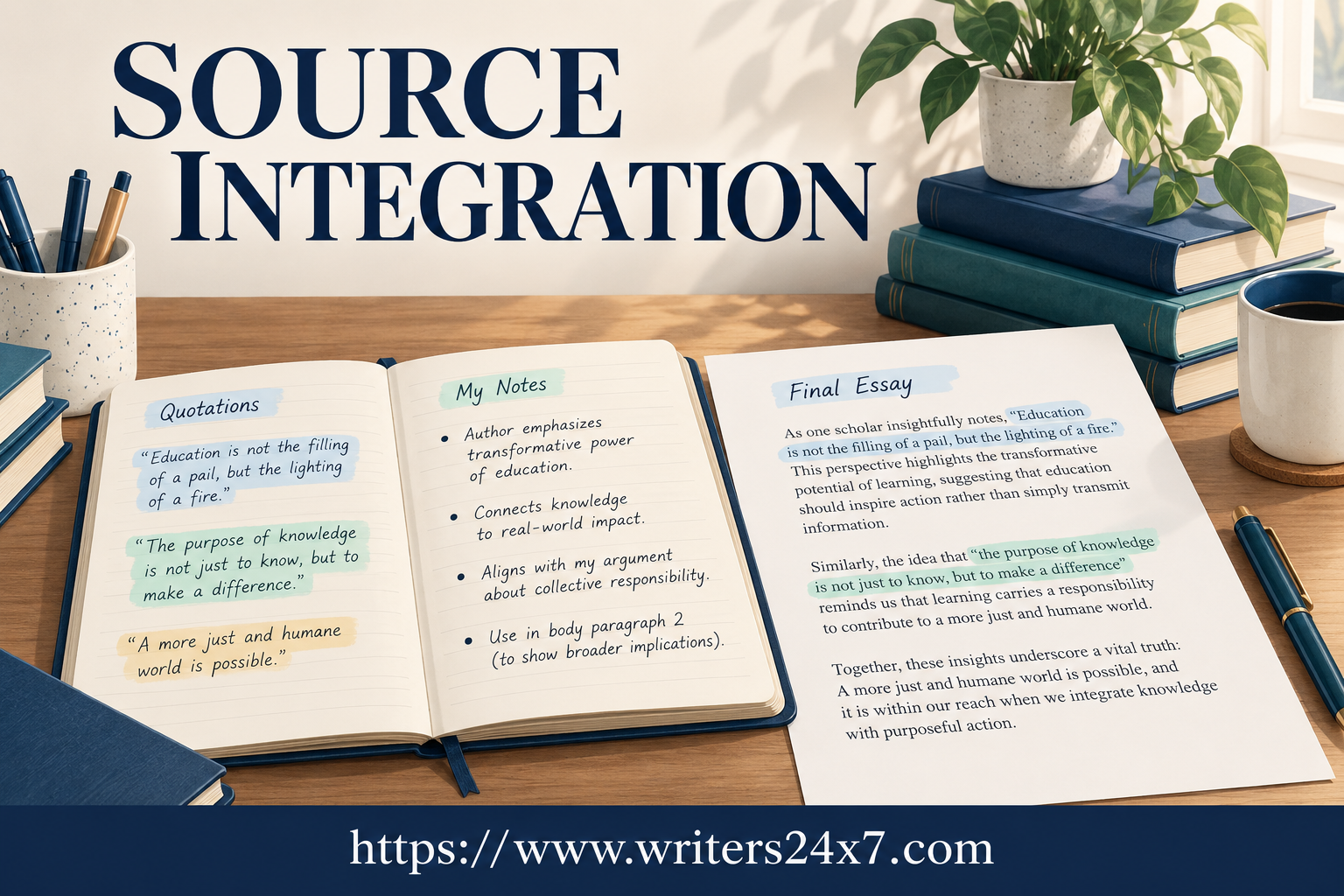
1. Give every source a clear job
Before collecting quotations, write your provisional answer to the assignment question in one sentence. Under it, list the smaller claims readers would need to accept. This map guides source integration.
Imagine an essay about access to university libraries. One paragraph might distinguish opening hours from actual accessibility. A policy document could establish the official schedule, while student interviews could explore practical obstacles. These sources answer different questions. Neither should be presented as a complete substitute for the other simply because both discuss libraries.
Effective source integration starts with that distinction. Add a short role label to each research note: background, definition, example, explanation, counterargument, or limitation. A source may serve more than one role, but identify the role it plays in the paragraph you are drafting. This keeps evidence connected to the local argument.
Remove material that does not advance the answer, even if finding it took time. Research effort does not automatically justify inclusion. Saving unused references in a separate file helps you cut confidently without losing useful material. Your final bibliography should document what you actually cite, following the requirements of the assigned referencing system.
2. Keep source integration notes traceable
Record the full reference, a stable link or identifier, and a page or section locator when you first read a source. Separate copied wording from your own notes immediately.
A source integration note typically contains: the source details, the relevant passage, your explanation of its meaning, the claim it could address, and any limitation. You do not need elaborate software. A document or spreadsheet works if the information stays searchable and the original wording cannot be mistaken for your own writing.
For source integration, context is as important as the extracted sentence. Note the population, setting, time period, and kind of evidence involved when those details affect interpretation. A finding about one university, for example, does not automatically establish a pattern across all universities. Preserve qualifications that materially limit the author’s conclusion.
When reading a source quoted by another author, distinguish the material you actually consulted from the original work. Follow your required style for secondary citations if you cannot access the original. Do not imply firsthand reading or copy bibliographic details uncritically. A short verification now prevents a much more difficult correction later.
3. Choose quotation, paraphrase, or summary deliberately
Use quotation when the precise wording is part of your analysis or when a compact formulation deserves close attention. Paraphrase when the idea matters more than its original expression. Summarize when readers need the broad argument or pattern rather than individual details. These source integration choices reflect purpose, not quotas for each technique.
Purdue OWL’s explanation of quoting, paraphrasing, and summarizing distinguishes these forms and their uses. All three require appropriate attribution. Changing the wording or shortening an argument does not make the underlying idea your own. Consult your course guidance for the exact citation format and any discipline-specific expectations.
For accurate source integration, read the relevant passage until you understand its point, then draft a paraphrase without looking at the wording. Compare your version with the original afterward. Check both meaning and structure. Replacing a few nouns while retaining the original sentence pattern is not a reliable paraphrasing method.
Preserve uncertainty. If the author suggests that a relationship may exist, do not rewrite the finding as proof that one factor causes another. Keep important distinctions between reported experience, measured association, theoretical explanation, and demonstrated effect. Precise verbs often improve source integration more than a larger number of citations does.
4. Introduce evidence with an accurate signal phrase
In source integration, signal phrases introduce borrowed material and identify its relationship to your claim. Reporting verbs carry meaning: an author may argue, describe, estimate, question, or observe something. Choose the verb that matches the source. Stronger sounding language is not better if it exaggerates what the author actually established.
Compare an invented sentence such as “The study proves that libraries are inaccessible” with “The interviews describe barriers experienced by participating students.” The second sentence gives readers a more precise account of what the evidence can support. It also creates room to discuss which barriers appeared, how participants were recruited, and where interpretation remains uncertain.
Source integration does not require beginning every sentence with an author’s surname. Sometimes the issue deserves the opening position, with attribution later in the sentence. Vary sentence structure according to emphasis while keeping ownership clear. The reader should always be able to distinguish a source’s finding from your interpretation of that finding.
Check that quotations fit grammatically into the surrounding sentence. Avoid attaching a quotation after an incomplete setup simply because the citation is correct. Read the whole sentence aloud, including your introductory words and the quotation. If the sentence feels awkward, revise the introduction or paraphrase the material instead of forcing the fit.
5. Explain the connection after presenting evidence
Source integration requires explicit reasoning. After introducing a relevant finding, explain the feature that matters to your argument. Identify what the evidence illustrates, why it is persuasive or limited, and how it affects the paragraph’s claim. This reasoning is where your contribution becomes visible, even when you are working entirely with published material.
A useful source integration sequence is claim, evidence, interpretation, and consequence. Treat it as a diagnostic rather than a rigid four-sentence template. Some paragraphs need two pieces of evidence before analysis; others need an extended explanation of one example. The important question is whether the logical connection remains clear to a new reader.
In the library example, you might explain that longer opening hours address scheduling but do not necessarily resolve transport or accessibility barriers. That inference must remain proportionate to the evidence supplied. State the connection explicitly rather than assuming readers will construct it. If the evidence does not support the inference, revise the claim.
Look for paragraphs that end immediately after a quotation. They may leave the source with the last word before you have explained its importance. An additional analytical sentence can help, but only if it adds reasoning. Repeating the quotation in simpler language without advancing the point is still description, not analysis.
6. Put sources into a focused conversation
When several sources address the same issue, organize the paragraph around that issue rather than around a sequence of author summaries. Ask where the sources agree, where their findings differ, and what could explain those differences. Different methods, settings, definitions, and time periods may matter more than a simple agreement-versus-disagreement label.
Suppose one hypothetical survey reports satisfaction with library opening hours while interviews describe difficulty using evening services. These accounts need not contradict each other. They may involve different students or different meanings of access. Careful source integration identifies the comparison point before drawing a conclusion about the relationship between the findings.
Avoid grouping citations after a broad sentence unless every cited source supports that statement. If one source supports only part of the claim, separate the clauses or sentences. Citation clusters can look authoritative while concealing important differences. Readers should be able to work backward from each claim to the relevant evidence.
For broader planning, the academic essay writing guide connects paragraph development with the overall argument. Use that larger structure to decide where a comparison belongs. Source integration becomes easier when you know what each section must establish before the essay can move to its next stage.
7. Include challenges without losing your position
Strong source integration addresses credible evidence that complicates an argument. Choose a meaningful challenge, represent it fairly, and explain its implications. Sometimes the challenge narrows your thesis rather than defeats it. A qualified conclusion can be more convincing than an absolute statement maintained by overlooking inconvenient findings or limitations.
During source integration, distinguish a limitation of the evidence from a weakness in your reasoning. A small study might still offer useful insight into a particular experience, even if it cannot establish prevalence. Explain what the study contributes within its scope. Do not dismiss evidence merely because it uses a method different from your preferred approach.
One practical revision question is: “What would an informed reader ask next?” They may want to know whether the example is typical, whether another explanation is possible, or whether conditions have changed. Answer the most relevant questions within the essay’s scope. You cannot resolve every uncertainty, but you can make your boundaries explicit.
Keep your position visible after discussing the challenge. State what remains supported, what requires qualification, and what cannot yet be concluded. This turns counterevidence into an opportunity for sharper reasoning. It also prevents the essay from becoming a disconnected collection of opinions with no clear judgment from the writer.
8. Audit citations and authorial voice together
Audit source integration paragraph by paragraph, marking the sentences that contain borrowed ideas. Check that attribution covers those ideas clearly without implying that an entire paragraph comes from a source when part of it is your analysis. Referencing conventions differ, so follow your institution’s guidance rather than applying a universal citation frequency rule.
Then highlight your own reasoning in another color. If almost nothing remains, the paragraph may need stronger analysis or a clearer claim. If the paragraph contains broad factual statements without evidence, it may need research. Source integration balances these responsibilities; it does not aim for an arbitrary percentage of quotations or original sentences.
If you use feedback from Writers24x7 or explore resources at EssayWave, keep your institution’s authorship rules central. Ask for explanations of unclear attribution or weak reasoning, then make and understand your own revisions. Assistance should help you learn a method you can apply to the next assignment.
Finally, compare in-text citations with the reference list. Check names, dates, titles, identifiers, and locators where required. Open important sources again rather than relying only on saved snippets. A polished bibliography cannot compensate for a claim that misrepresents the underlying evidence, so accuracy and formatting should be checked together.
9. Practice source integration with a small revision task
Choose one paragraph from your draft that contains two references. Write its main claim in the margin. For each reference, identify its role and the exact point it supports. Remove any material that does not serve the claim. Rewrite the explanation between the pieces of evidence so their relationship becomes explicit.
Next, close the sources and explain the paragraph aloud in ordinary language. If you cannot explain how the evidence supports your point, return to the reading before polishing the prose. This simple source integration exercise tests understanding and often reveals that the paragraph needs a narrower claim rather than more sophisticated vocabulary.
Repeat the process with a paragraph containing a challenge to your argument. Finish by checking that the revised thesis reflects any important qualification. Save the earlier version so you can compare the reasoning before and after revision. The goal is a clearer chain of thought that a reader can inspect and follow.
Worked example: source integration in a comparative paragraph
Consider a practice assignment asking whether longer library opening hours are sufficient to improve access. Imagine two fictional sources: a survey about preferred study times and interviews about travel difficulties. Neither source is a real study, and the sentences below are teaching examples. In an actual assignment, replace them with accurately cited evidence from material you have read.
A weak draft might say: “The survey discusses opening hours. The interviews discuss transport. Both sources show that libraries should stay open later.” The final sentence goes beyond the evidence described. The interviews might suggest that later opening alone would not help students who cannot travel home safely or affordably. Listing two sources has created an appearance of support without establishing the reasoning.
Better source integration begins by separating the contributions. The survey could help explain demand for evening study, while the interviews could identify conditions that affect whether students can use those hours. Write a narrower claim first: “Extending opening hours may increase opportunities for study, but the usefulness of those opportunities also depends on practical access.” The claim now leaves room for both findings.
Next, introduce the evidence in the order needed by that claim. Describe what survey participants reported, then identify the transport issue raised in the interviews. Explain that preference and usability answer related but different questions. This is the analytical connection. It should come from a defensible comparison of the source material, rather than from an assumption that two references automatically establish the same conclusion.
The source integration task also requires a limitation. Perhaps the fictional survey covers one campus while the interviews involve a small group of commuters elsewhere. That difference prevents a direct estimate of how many survey respondents face transport barriers. It does not necessarily prevent a cautious conceptual comparison. Explain the distinction so readers know what the paragraph establishes and what remains untested.
During revision, label each sentence as claim, evidence, interpretation, or qualification. The labels are temporary planning aids and should disappear from the final essay. If you find three evidence sentences and no interpretation, ask what the reader still needs to understand. If you find a confident conclusion without supporting evidence, narrow the conclusion or return to the research.
An attribution check completes this source integration example. Ensure that the survey citation accompanies the survey finding and the interview citation accompanies the interview finding. Avoid placing both citations at the end of a long paragraph if that makes their coverage ambiguous. Follow the required referencing style for repeated citations and locators, and distinguish your comparison from either author’s original claims.
You can practise source integration without rewriting the entire essay. Select one paragraph, save a copy, and spend ten minutes identifying the function of each reference. Then revise only the connections between evidence and claims. Compare the versions by asking whether a reader could explain why each source belongs there. A longer paragraph is not automatically a better result; a clearer relationship is.
Finally, test your source integration with a short explanation in your own words: “This source helps establish this point, within these limits.” If the explanation feels vague, reread the source and reconsider its role. If it sounds precise, check that the actual paragraph communicates the same reasoning. This habit makes future research notes more selective because you begin reading with the eventual argument in mind.
Frequently asked questions
How many sources should each paragraph include?
There is no universal number. Use enough evidence to support the paragraph’s purpose and meet the assignment requirements. A close analysis may focus on one source, while a comparative paragraph may need several. Source integration depends on relevance, accuracy, and explanation rather than filling every paragraph with the same citation count.
Can a paraphrase still be too close to the original?
Yes. A paraphrase can preserve too much wording or sentence structure even when some words change. Draft from understanding, compare with the original, and retain a citation. Put distinctive borrowed wording in quotation marks when appropriate. If you cannot explain the idea independently, reread before attempting another version.
What should I check first when revising?
Start with the relationship between the claim and the evidence. Then check representation, analysis, and attribution. Correct punctuation matters, but source integration problems often begin earlier: the selected passage may not answer the question the paragraph asks. Fixing that mismatch makes later editing much more productive.