An essay introduction gives readers the information they need to understand your question, recognize its importance, and follow your answer. It does not need to begin with a dramatic quotation or a sweeping claim about human history. A focused opening often works better because it establishes the actual problem the essay will examine.
This guide explains how to build an essay introduction around context, a precise problem, a defensible thesis, and an appropriate roadmap. The examples are invented for learning. Use them as models of reasoning rather than sentences to submit, and adapt the advice to your assignment brief, subject, and required essay type.
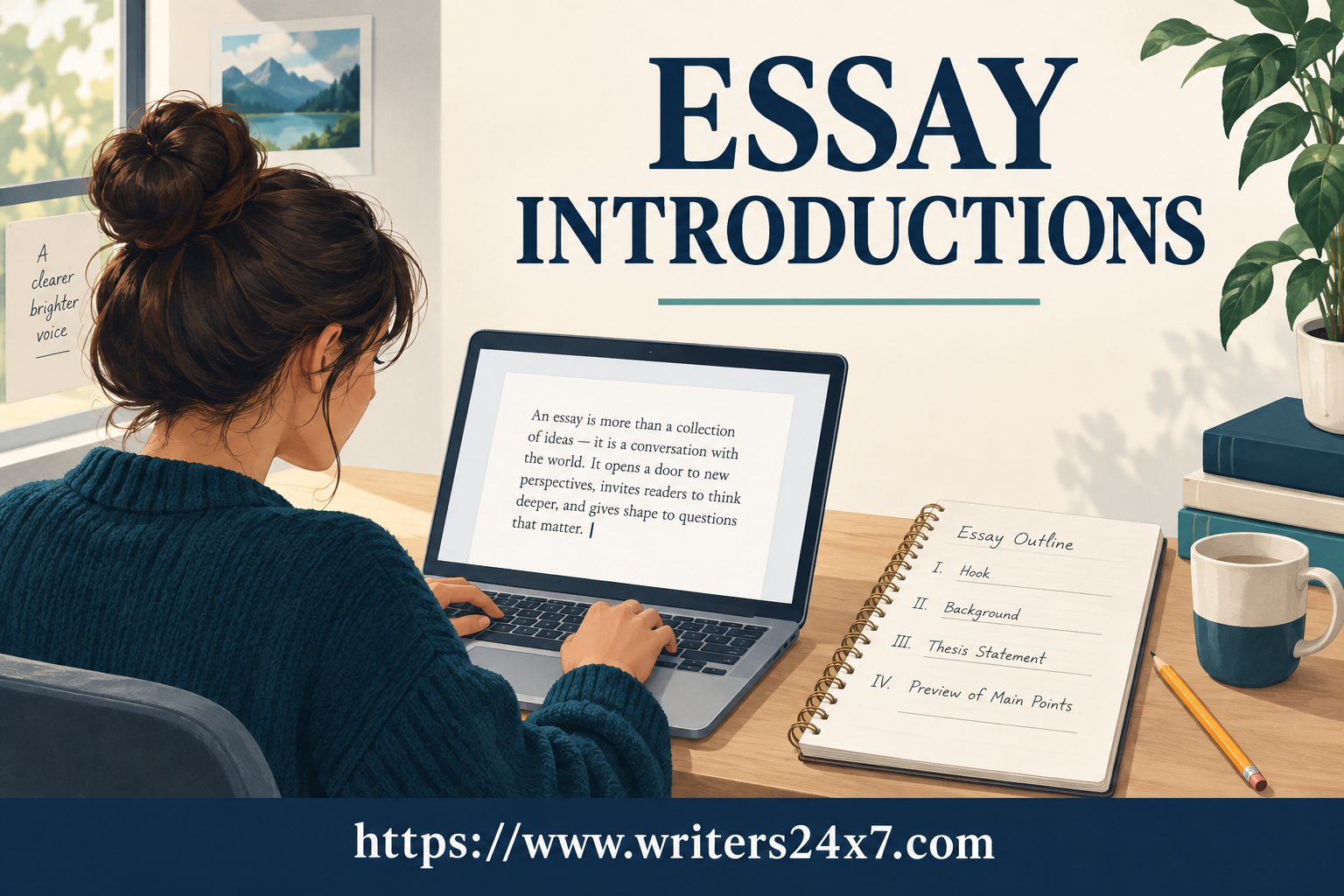
1. Match your essay introduction to the assignment
Before drafting your essay introduction, underline task words in the assignment: analyze, compare, evaluate, explain, or discuss. These words suggest different kinds of intellectual work. An introduction to an evaluative essay should prepare readers for a judgment based on criteria, while an explanatory essay may need to establish a process or relationship.
Write a plain-language version of the task in your notes. Then identify its boundaries, including the time period, setting, texts, population, or concepts you must address. If the question is broad, decide what you can realistically examine within the word limit. Check that decision against the rubric before building an argument around it.
Your essay introduction should reflect these boundaries. A paper comparing two novels does not need to promise a conclusion about all literature. A short policy essay cannot usually resolve every aspect of a national debate.
Keep the original prompt visible while drafting. After writing the introduction, compare each sentence with the task. A sentence may be interesting yet unrelated to the required answer.
2. Begin your essay introduction with relevant context
Essay introduction context establishes the discussion your argument enters. Start close enough to the topic that readers can see its relevance immediately. If the essay concerns evening access to a university library, you might begin with the relationship between opening hours and student access. You probably do not need a history of libraries from antiquity.
Choose context according to the intended audience. A specialist reader may already understand the basic concept, while a general academic audience may need a brief definition. Avoid explaining familiar terms at length while leaving the essay’s central distinction undefined. The best opening information is the information that makes the upcoming problem understandable.
A useful essay introduction moves from relevant context toward a specific question. It need not follow a rigid funnel from the broadest possible statement to the narrowest detail. Some essays can begin directly with a disagreement, a textual puzzle, or a practical limitation. The opening should serve the argument rather than imitate a formula.
Verify factual claims in the context section. Dates, statistics, policy descriptions, and statements about what researchers generally believe may need evidence. Do not invent an impressive number or claim a universal consensus to create a hook. If a detail is unnecessary to the argument, removing it may be better than adding another citation.
3. Explain the problem the essay addresses
A topic names an area; a problem explains what needs attention within it. “Library access” is a topic. The difference between longer opening hours and students’ ability to use those hours is a possible problem.
Look for a tension, uncertainty, competing interpretation, or limitation. In a literature essay, two passages may appear to support different interpretations of a character. In a policy essay, a proposed benefit may involve a tradeoff. In a comparative essay, similar outcomes may arise through different mechanisms. State the issue your analysis will actually investigate.
An effective essay introduction does not exaggerate the problem. You do not need to claim that nobody has considered the issue before. For a course essay, the value may lie in applying a concept, comparing explanations, or evaluating evidence carefully. The opening should promise a useful analysis at the scale the assignment can support.
Test your essay introduction by asking a reader what question they expect the essay to answer. If their interpretation differs substantially from yours, revise the wording. This quick check can reveal vague terms or missing context before they spread into the outline. A shared understanding of the question makes the rest of the argument easier to follow.
4. Write a thesis that gives an answer
An essay introduction thesis states the central position or answer. It should do more than announce the topic. “This essay discusses library opening hours” tells readers what the paper concerns, but not what it argues. A more useful thesis identifies the relationship or judgment the body paragraphs will establish through analysis and evidence.
For an invented example, a thesis might argue that extending opening hours improves access only when transport and service availability are also considered. This creates specific responsibilities for the body: explain the benefit, examine the additional barriers, and justify the qualification. The thesis becomes a working plan for the reasoning rather than a decorative final sentence.
Your essay introduction can contain a provisional thesis during drafting. As research develops, revise it to match what the evidence supports. Do not preserve an absolute claim simply because you wrote it first.
Check whether the thesis answers the actual assignment, can be explained within the word limit, and gives the body paragraphs a coherent purpose. The academic essay writing guide develops this connection between thesis and structure. Use the introduction and outline together so they describe the same argument.
5. Define only the terms readers need
Definitions can prevent confusion when a word has a specialized meaning or when your argument depends on a distinction. Explain how the term functions in this essay rather than automatically quoting a dictionary. If a discipline has an established definition, use an appropriate source and represent any relevant disagreement or limitation accurately.
For example, an essay may distinguish access from availability. Availability could refer to whether a service exists at a given time, while access may involve whether particular users can practically use it. If that distinction drives the argument, introduce it early. Otherwise, readers may interpret later claims using a different meaning from the one you intend.
Keep definitions in the essay introduction concise. Detailed conceptual debates may belong in a later section where you can examine them properly. The opening should provide enough clarity to understand the thesis without becoming a miniature literature review. Move material when it interrupts the path from context to problem to answer.
Use essay introduction terminology consistently afterward. Do not define a narrow concept in the introduction and then use the same word broadly in the conclusion. During revision, search for key terms and check their meaning in each location. Consistency helps readers evaluate the argument because its central concepts remain stable across the paper.
6. Add a roadmap when it improves clarity
A roadmap tells readers how the essay will develop its answer. In a longer paper, it may identify major stages such as defining the issue, comparing explanations, and evaluating implications. In a short essay, the thesis may already make the structure clear. Include signposting because readers need it, not because every introduction must contain a fixed list.
Make your essay introduction roadmap conceptual, not numerical. “First, this essay discusses one issue, then another” gives little useful information. A stronger version explains that the essay distinguishes service availability from practical access before evaluating proposals to improve both. This shows the logic behind the sequence and makes the organization easier to remember.
An essay introduction should promise only the analysis the paper delivers. If you remove or rearrange a section during revision, update the roadmap. A mismatch creates avoidable confusion even when individual sections are well written. Read the introduction beside the final outline rather than relying on memory of the version you initially planned.
Avoid excessive announcements such as “In this essay, I will now attempt to discuss.” Use direct language appropriate to your discipline. Some courses welcome first person; others prefer different conventions.
7. Choose an opening strategy that fits the topic
A focused question, a brief example, a relevant observation, or a clear statement of a disagreement can all begin an essay effectively. Choose the strategy that leads naturally to your problem. A surprising fact is useful only if it is accurate, relevant, and explained. Attention without direction does not make an introduction effective.
If you begin with a question, make sure the essay answers it. Avoid asking several broad questions that the body cannot address. If you begin with an example, establish whether it is real, hypothetical, or drawn from a text. Readers should not mistake a teaching illustration for documented evidence about an actual event or population.
A quotation should earn its place in an essay introduction. Explain why its precise wording matters to your argument. Beginning with a famous person’s statement can feel detached if the person or idea never appears again. Often, your own clear explanation of the issue provides a stronger opening and leaves more space for the thesis.
Try drafting two different opening sentences after the body is complete. One can state the problem directly; the other can approach it through a concise example. Read each with the rest of the introduction.
8. Revise your essay introduction after writing the body
The finished body often reveals the essay’s real emphasis more clearly than the initial plan did. Return to the opening and check its claims against the analysis you actually completed. Adjust the thesis, scope, and roadmap when needed. This is a normal part of writing, not evidence that the first draft was a failure.
Read the essay introduction beside the conclusion. They should address the same question, though the conclusion can express a more developed understanding after the evidence has been examined. If they appear to belong to different essays, identify where the argument changed. Then revise the opening or the body so the paper becomes coherent.
Cut background that never becomes relevant. Move detailed evidence into the appropriate body section. Replace broad claims with precise statements and explain unexplained terms. These edits often make the introduction shorter, but length is not the only goal. Preserve the information a reader genuinely needs to understand the argument’s purpose and boundaries.
If you request feedback through Writers24x7 or review resources at EssayWave, ask specific questions about clarity, scope, and thesis alignment. Use the feedback to improve your own work in accordance with institutional rules. You should be able to explain every claim and every structural choice in the final version.
9. Use a practical essay introduction checklist
Before submitting, identify the sentence that establishes context, the sentence that states the problem, and the sentence that gives your answer. These functions may overlap, and they do not need to appear in a fixed number of sentences. What matters is whether readers can locate the information without guessing what the essay intends to do.
Next, check your essay introduction against the rubric. Confirm that the scope is manageable, key terms are clear, factual statements are supported, and the roadmap matches the body. Read the introduction aloud to catch long sentences and vague references. Mark any phrase that sounds impressive but contributes little meaning, then simplify or remove it.
Finally, give the essay introduction to someone who has not read the body. Ask them to describe the expected argument in one sentence. Compare that description with your thesis and outline. If the expectations match, the opening is doing its job: preparing the reader for the specific analysis the essay will deliver.
Worked example: build and test an essay introduction
Suppose an assignment asks you to evaluate whether extending university library opening hours is sufficient to improve student access. A useful opening must prepare readers for an evaluation, not simply describe libraries. The following example is hypothetical. It demonstrates how to move from context to a focused problem and an answer without making unsupported factual claims about an actual institution.
A weak draft might begin: “Libraries have always been very important. Students need to study, and universities should help them. This essay will discuss library hours.” These sentences give little direction. The first makes an unnecessary historical claim, the second remains broad, and the third announces a topic without establishing a position. The reader cannot yet tell what criteria will guide the evaluation.
For a stronger essay introduction, begin with the distinction that makes the question interesting: “A library can be available at a particular time without being equally usable by every student.” This sentence establishes a conceptual problem rather than inventing a statistic. The next sentence can identify possible conditions, such as travel arrangements or the availability of required services, that the essay will examine using appropriate evidence.
Then state a qualified answer. For example: “Extending opening hours can increase opportunities for study, but its adequacy should be evaluated alongside the practical conditions that determine whether students can use those opportunities.” This thesis creates a clear analytical task. The body must explain the potential benefit, examine relevant conditions, and justify the criteria used to judge whether the proposal is sufficient.
The essay introduction may finish with a short roadmap if the structure needs explanation. A suitable roadmap would identify the conceptual distinction, the evidence about practical barriers, and the evaluation of possible responses. Avoid promising a detailed cost analysis if the paper contains no financial evidence. Every promise in the opening should correspond to work the completed essay actually performs.
This example also shows why drafting the essay introduction is an iterative process. You might initially expect transport to be the central issue, then find that the available material supports a different emphasis. Revise the opening to reflect that evidence. Do not force the body to defend an early assumption merely to preserve the first version of the thesis.
Try a three-column review of your own opening. In the first column, copy each sentence. In the second, identify its function: context, problem, definition, answer, or roadmap. In the third, explain why the reader needs it. If you cannot name a useful function, revise or remove the sentence. If a necessary function is missing, add the information that makes the argument understandable.
Next, check the essay introduction for terms whose meanings might shift. In this example, “access,” “availability,” and “usability” need consistent treatment. You may not need a separate definition for every word, but you should understand the distinction yourself. Read the thesis and conclusion together to make sure they evaluate the same idea rather than quietly changing the standard of success.
Finally, ask someone to read only the essay introduction and predict the body’s main responsibilities. Compare their prediction with your outline. Differences do not automatically mean the reader is wrong; they may reveal an ambiguous promise or missing qualification. Revise until the opening accurately prepares someone for the argument you have written. That alignment matters more than a dramatic hook or a rigid introductory formula.
Frequently asked questions
How long should an essay introduction be?
Follow the assignment’s guidance and the needs of the paper. A short essay usually needs less background than a long research paper, but there is no universal sentence count. Include enough context, problem definition, and direction for readers to understand the argument. Remove detail that belongs in the body or does not support that purpose.
Can I write the introduction last?
Yes. You can begin with a provisional introduction or a few planning notes, draft the body, and then write the opening when the argument is clearer. An essay introduction often improves through this process because its thesis and roadmap can reflect the analysis actually developed rather than the analysis originally imagined.
Does every introduction need a hook?
It needs a reason for readers to engage with the question, but that reason need not be a dramatic hook. A precise problem, meaningful distinction, or well-framed disagreement can create interest. Prioritize relevance and clarity so the opening leads directly into the argument you are prepared to support.