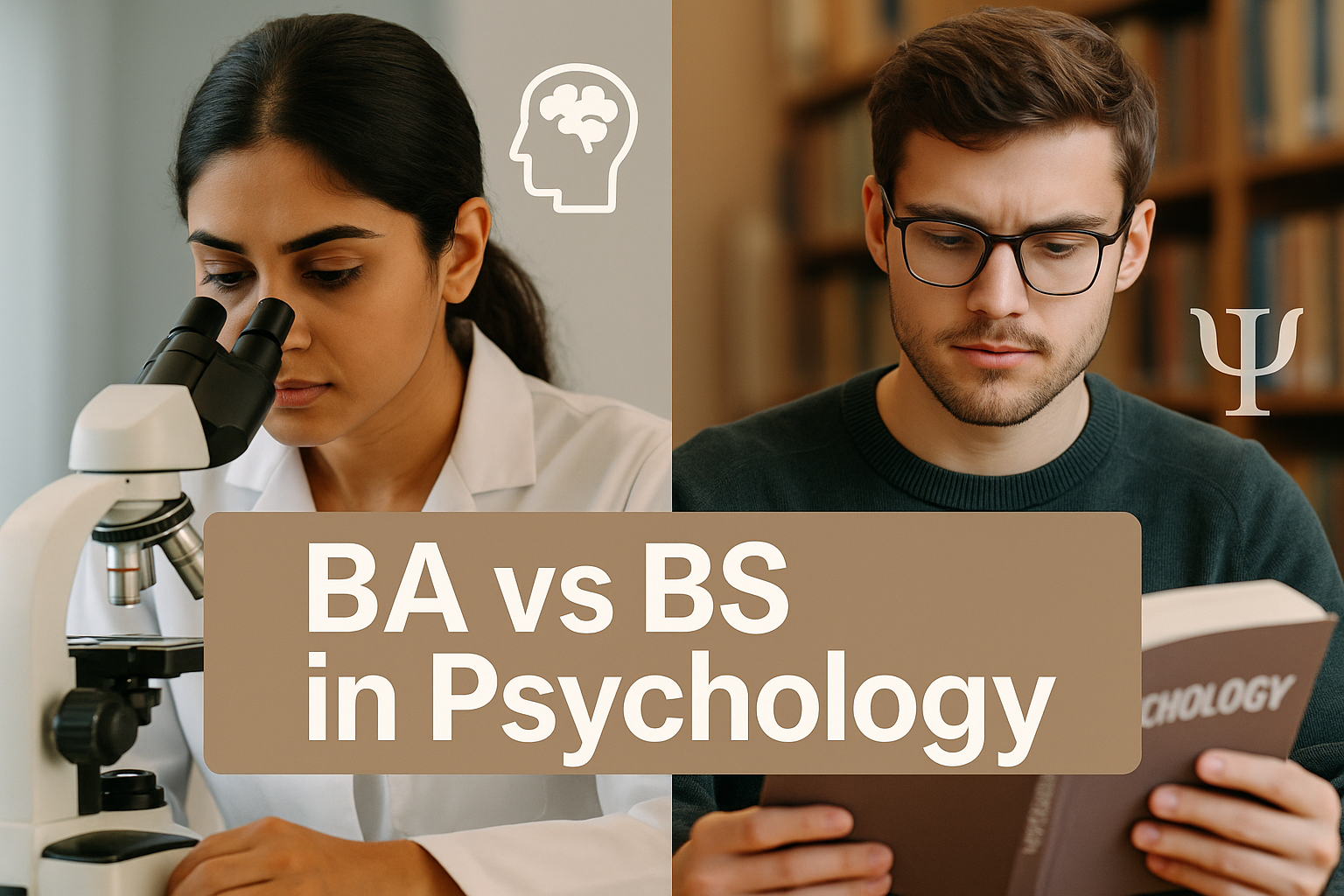
When you’re researching undergraduate psychology programs, you’ll quickly encounter two main degree tracks: the Bachelor of Arts (BA) and the Bachelor of Science (BS) in Psychology. Understanding the difference between a BA and a BS in Psychology can help you choose the path that best aligns with your academic interests, career ambitions, and learning style.
Table of Contents
ToggleWhat Is a BA in Psychology? BA and a BS in Psychology
A BA in Psychology typically emphasizes the liberal arts perspective, combining psychological theory with broader studies in humanities and social sciences.
Curriculum Focus:
Courses in sociology, philosophy, foreign language, and communications
Emphasis on qualitative research methods, critical writing, and cultural context
Skills You’ll Develop:
Analytical writing and critical thinking
Interpersonal communication and cultural competence
Theory-driven approaches to behavior
Ideal For Students Who:
Love exploring human behavior through case studies and text analysis
Plan to pursue careers in counseling, social work, education, or human resources
Want a flexible schedule with room for electives in the arts and humanities
What Is a BS in Psychology? BA and a BS in Psychology
A BS in Psychology gears toward a scientific and technical approach, with stronger requirements in math, natural sciences, and data analysis.
Curriculum Focus:
Courses in statistics, biology, neuroscience, and research design
Emphasis on quantitative research methods, lab work, and empirical studies
Skills You’ll Develop:
Statistical analysis and experimental design
Laboratory techniques and data interpretation
Scientific writing and technical reporting
Ideal For Students Who:
Are passionate about research, neuroscience, or clinical experimentation
Plan to continue into graduate programs (e.g., PhD, PsyD) in psychology, neuroscience, or psychiatry
Thrive in math-heavy and lab-based environments
Curriculum Comparison: BA vs. BS in Psychology
| Component | BA in Psychology | BS in Psychology |
|---|---|---|
| General Education | Broad – arts, humanities, and languages | Focused – math, biology, and chemistry |
| Major Requirements | 8–10 core psych courses + electives | 10–12 core psych courses + lab sciences |
| Research Methods | Qualitative methods, case studies | Quantitative methods, statistics, labs |
| Capstone/Thesis | Literature review or independent project | Empirical research thesis with data |
Career Paths: BA vs. BS in Psychology
While both degrees open doors in psychology and related fields, the career trajectories can differ:
With a BA in Psychology, you might pursue:
Social Work: Assisting clients and communities.
Human Resources: Recruiting, training, and employee relations.
Education & Counseling: School counseling or educational support roles.
Marketing & Communications: Consumer behavior analysis.
With a BS in Psychology, you might pursue:
Research Assistant: Supporting lab-based psychological research.
Data Analyst: Interpreting behavioral data in healthcare or tech sectors.
Clinical Technician: Working in neuroscience or neuropsychology labs.
Graduate Studies: Leading toward clinical psychology, neuropsychology, or cognitive science.
How to Choose: Key Considerations : BA and a BS in Psychology
Your Academic Strengths & Interests
Enjoy writing papers, exploring cultural contexts, and creative projects? A BA may be a better fit.
Love statistics, experiments, and scientific inquiry? Lean toward the BS track.
Graduate School Plans
For research-intensive graduate programs (e.g., PhD), a BS demonstrates strong quantitative preparation.
For master’s programs in counseling or social work, a BA provides solid humanistic foundations.
Elective Flexibility
BA programs often allow more electives in art, language, or business.
BS programs may require extra lab sciences, leaving fewer open electives.
Career Goals & Licensing
Positions requiring licensure (e.g., clinical psychology) typically require graduate degrees—choose the track that aligns with your intended specialization.
FAQs About BA vs. BS in Psychology
Q1: Can I switch from a BA to a BS (or vice versa)?
Yes—but you may need to complete additional coursework (e.g., statistics for BA → BS or a foreign language for BS → BA).
Q2: Which degree has higher job prospects?
Both are respected; job prospects hinge more on experience, internships, and graduate credentials than on BA vs. BS alone.
Q3: Is one degree more expensive?
Tuition is typically the same; however, BS lab fees may add to overall costs.
Choosing between a BA vs. BS in Psychology boils down to your personal interests, academic strengths, and career aspirations. Whether you prefer a liberal arts approach with a BA or a scientific path with a BS, both degrees pave the way to rewarding opportunities in research, clinical practice, education, and beyond.
👉 Ready to take the next step? Explore our comprehensive psychology tutoring and assignment support services designed for both BA and BS students—Contact us today!
Program Length & Coursework Load : BA and a BS in Psychology
BA in Psychology: Typically 120–128 credit hours over four years, including 40–50 credits in psychology and 70–80 credits in general education and electives.
BS in Psychology: Also 120–128 credits, but with 50–60 credits in psychology and natural sciences (biology, chemistry) plus fewer electives.
Typical Semester Breakdown:
Year 1–2: Introductory psychology, general education (BA: humanities; BS: sciences).
Year 3: Intermediate courses (research methods, abnormal psychology), lab work (BS), and electives.
Year 4: Advanced seminars, capstone project or thesis, and practicum/internship opportunities.
Accreditation & Program Reputation
When comparing BA and BS programs, check for:
Regional Accreditation: Ensures transferability and graduate-school recognition.
APA-Approved Programs: Especially important if you plan to pursue clinical licensure.
Undergraduate Research Opportunities: Look for faculty-led labs, funded research grants, and conference presentations.
Average Starting Salaries & Outlook
| Degree Track | Entry-Level Roles | Median Starting Salary (USD)¹ | 10-Year Job Growth Forecast² |
|---|---|---|---|
| BA | HR Assistant, Behavioral Health Tech | $40,000–$45,000 | 8% (Average) |
| BS | Research Assistant, Data Analyst | $45,000–$50,000 | 12% (Above Average) |
¹ Payscale, “Psychology Graduate”
² Bureau of Labor Statistics, “Psychologists and Related Occupations”
Tips for a Strong Psychology Application
Highlight Research Experience: Even BA applicants benefit from being involved in faculty labs or independent projects.
Show Quantitative Skills: BS candidates should list statistics courses and software proficiencies (SPSS, R).
Detail Relevant Internships: Include counseling centers, HR departments, or neuroscience labs.
Craft a Personal Statement: Explain why you’re drawn to psychology’s theoretical or scientific dimensions.
Secure Strong Recommendations: Seek professors who can speak to your analytical or interpersonal strengths.
Conclusion & Next Steps
Whether you pursue a BA or BS in Psychology, your choice will shape your academic focus, skill set, and career possibilities.
Opt for a BA if you value interdisciplinary learning, cultural context, and applied people-centric roles.
Choose a BS if you’re excited by lab work, data analysis, and research-intensive graduate paths.
👉 Ready to excel in your psychology journey?
Leverage our expert tutoring, application review, and assignment support services—tailored for both BA and BS students. Contact us now to get started!
This post is part of our “Psychology Degree Insights” series. Subscribe for weekly updates on program comparisons, career advice, and study strategies!