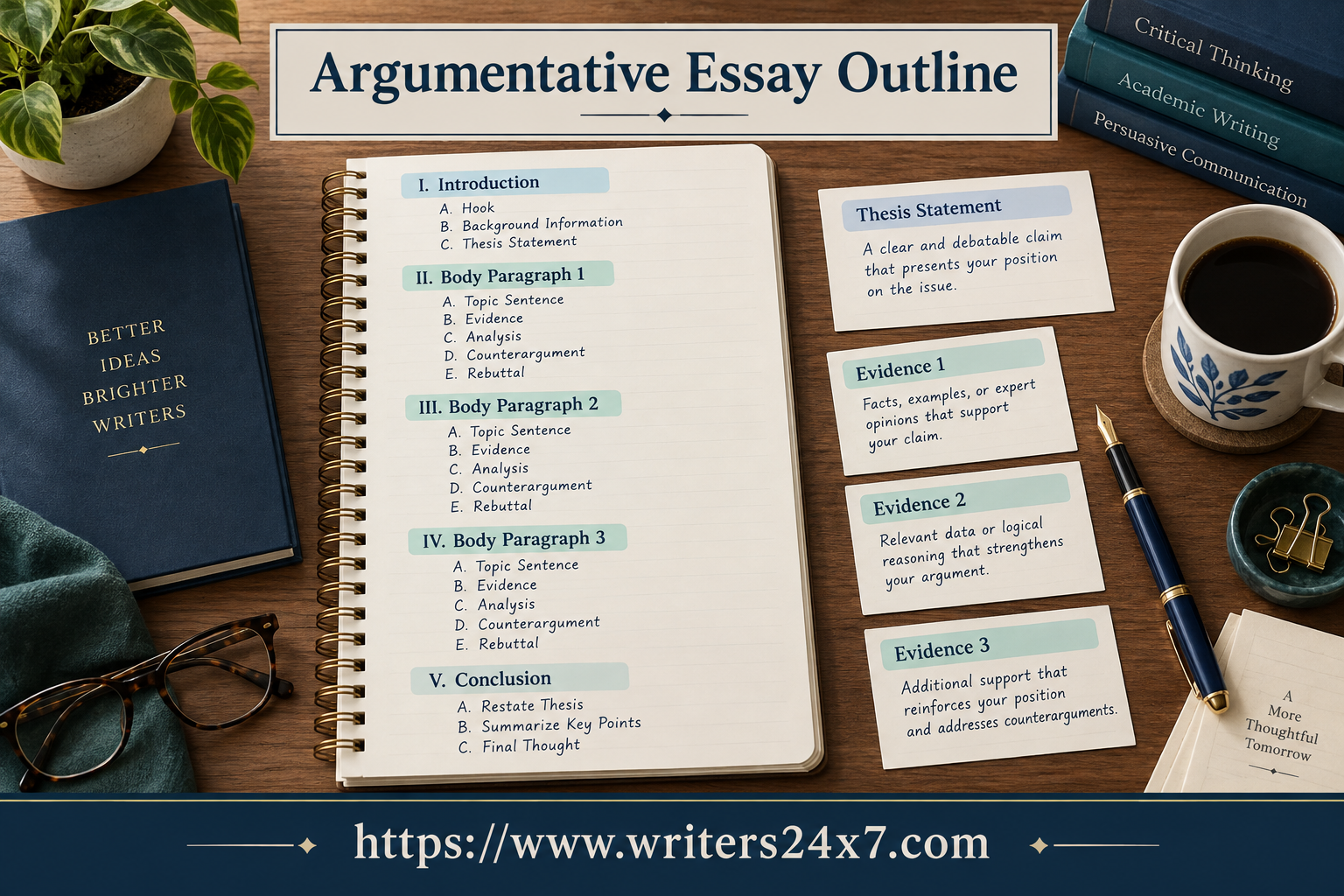
An argumentative essay outline shows how a claim will be supported before you invest hours in drafting. It connects your thesis to reasons, evidence, analysis, and the objections a thoughtful reader might raise. The aim is not to fill a rigid template. It is to make the logic of the essay visible while changes are still easy to make.
Many students begin with an introduction, three empty body paragraphs, and a conclusion. That arrangement can be a useful starting shape, but it does not explain what each section needs to establish. A stronger essay outline names the intellectual work of every part: define the problem, justify a claim, examine a complication, or explain a consequence.
This guide develops an argumentative essay outline through ten planning steps. The examples concern fictional university writing assignments and do not represent findings from real studies. Adapt the process to your course requirements, discipline, available evidence, and word limit. A successful plan is specific enough to guide writing and flexible enough to improve when your understanding changes.
1. Translate the assignment into a question
Read the brief for its task, scope, and evidence requirements. A prompt asking you to evaluate a policy differs from one asking you to interpret a passage or compare competing explanations. Underline the main instruction and write a plain-language question that your essay must answer. Keep this question beside the essay outline throughout planning.
Suppose the assignment asks whether universities should provide structured peer feedback before essay submission. A useful planning question is: under what conditions would structured peer feedback make a worthwhile contribution to a writing course? This is more focused than a general topic such as student learning. It also leaves room to examine conditions and limitations.
Record practical boundaries: required readings, permitted sources, approximate length, and any specified format. Your argumentative essay outline should respond to those boundaries rather than to a generic model found online. If the task asks you to analyze a provided text, a large collection of outside sources may distract from the required work.
2. Write a provisional thesis
A thesis gives the essay a central answer. It should make a claim that requires explanation and support, rather than announce a subject. Peer feedback is an important topic is an announcement. Universities should integrate guided peer feedback into selected writing tasks, with explicit criteria and opportunities to revise is a position that can be examined.
Keep the thesis provisional while you read. You may discover that the evidence supports a narrower claim or that an apparently minor condition is central to the argument. Revising the thesis is not a planning failure. It is a sign that the claim is responding to evidence instead of demanding that every source agree with it.
At the top of the argumentative essay outline, write both the question and the working thesis. Compare them directly. Does the thesis answer the actual question? Does it promise more than the available space can establish? If the relationship is unclear, resolve it before arranging paragraphs.
3. Identify the reasons the thesis needs
Ask what a reader would need to accept before accepting the thesis. For the fictional peer-feedback argument, the essay might need to establish why practice in evaluating writing matters, how guidance affects the usefulness of comments, and why revision opportunities are necessary. These are possible lines of reasoning, not conclusions that can be assumed without evidence.
Write each reason as a sentence rather than a topic label. A heading such as benefits is too broad to guide drafting. A sentence such as explicit criteria help students connect comments to the purpose of the assignment identifies something the paragraph must explain and support. It also makes gaps in reasoning easier to notice.
Do not force the argumentative essay outline to contain exactly three reasons. Some assignments need two developed lines of reasoning; others need several connected sections. The number should follow the complexity of the claim and the available word count. Adding a weak reason merely to complete a template usually weakens the essay outline.
4. Match evidence to each reason
Under every reason, note the evidence that could support it. Identify the source, the relevant finding or passage, and the location you will need later. A reference alone is not an evidence plan. You should be able to explain what the source contributes to this particular point and why it belongs here.
Distinguish evidence from a source’s interpretation. A study might report that students valued a feedback activity without measuring whether their writing improved. Those findings could inform a discussion of experience or engagement, but they should not automatically support a claim about performance. Record this distinction in the argumentative essay outline before it disappears inside polished prose.
Mark missing evidence explicitly. Write needs support or verify this interpretation rather than inventing a citation or leaving a confident sentence in place. These notes turn the essay outline into a research checklist. They also help you decide whether to find additional material, qualify the claim, or remove a point that cannot be supported.
5. Plan the analysis between evidence and claim
Evidence does not explain its own significance. After each planned source, add a note answering: how does this help establish the reason, and how does that reason support the thesis? This is the analytical connection that readers need. Without it, the essay can become a sequence of quotations or summaries that never develops an argument.
For example, a source about students’ difficulty interpreting feedback criteria might support a discussion of why preparation matters. Your analysis would need to explain the relationship between understanding criteria and producing useful comments. It should also acknowledge what the source does not show, especially if it comes from a different setting or examines a different activity.
In the argumentative essay outline, give analysis its own space. A simple planning pattern is claim, evidence, explanation, qualification, and connection. The final paragraph does not have to follow that order mechanically. The pattern is a diagnostic tool that helps you check whether you have included the necessary reasoning.
6. Arrange sections in a logical sequence
Choose an order that helps the reader understand the argument as it develops. Sometimes you need to define a disputed term before evaluating evidence. Sometimes you need to explain a problem before comparing responses. In other essays, a strong objection provides the most useful starting point because answering it reveals the central distinction.
Read only the planned section claims, without the evidence notes. Do they form a connected explanation? If one section assumes something not yet established, consider moving it or adding a necessary bridge. If two sections make essentially the same point, combine them and use the space for analysis that advances the argument.
A useful argumentative essay outline includes a one-sentence explanation of the sequence. For instance: the essay first defines the purpose of peer feedback, then examines the conditions that make it useful, and finally addresses implementation concerns. If you cannot explain the order simply, the structure may still be driven by the order in which you found sources.
7. Include a serious counterargument
Identify the strongest reasonable challenge to your thesis. Avoid choosing an obviously weak objection merely because it is easy to dismiss. A reader might question the reliability of student comments, the time required for preparation, or the relevance of evidence from another subject. The objection should engage with the actual claim you are making.
The Harvard College Writing Center’s counterargument guidance emphasizes considering challenges that readers could reasonably raise. Use that principle to test your essay outline: have you understood the objection fairly, and would someone who holds it recognize your description? A fair account makes your response more credible.
Then decide whether the objection should be answered, conceded, or used to narrow the thesis. You might accept that peer feedback cannot replace expert assessment while arguing that this does not rule out a carefully defined learning role. The argumentative essay outline should show how the objection changes or strengthens the reasoning, rather than treating it as an isolated paragraph added near the end.
8. Plan an introduction that establishes the issue
Your introduction should give the reader enough context to understand the question and why it matters. It does not need to begin with a sweeping claim about humanity, education, or the modern world. Specific context is usually more useful: identify the relevant debate, define the problem, and lead toward the thesis.
In the essay outline, list the information the introduction genuinely needs. This might include a short definition, the tension between two priorities, or a brief explanation of the assignment’s case. Avoid planning a long background section simply because you have collected information that feels interesting. Context earns its place by making the argument understandable.
Write the introduction last if that helps you. An argumentative essay outline can contain a provisional introduction note while the body structure develops. Once the reasoning is clear, you can write an opening that accurately represents the essay you have, rather than the essay you initially imagined.
9. Give the conclusion a purpose
A conclusion should answer the essay question in light of the reasoning developed. It can restate the central position, explain its most important qualification, and identify the implication that follows. It should not introduce a new major source or a new line of argument that the body has not prepared the reader to evaluate.
For the fictional example, the conclusion might explain that the case for peer feedback depends on its educational purpose and design. It could emphasize that a structured learning activity and a replacement for instructor assessment are different proposals. That distinction would summarize the argument’s contribution rather than merely repeat its headings.
Add a conclusion note to the argumentative essay outline before drafting. Ask what the reader should understand differently by the end. If the answer is only that the topic has advantages and disadvantages, the thesis may need a more precise judgment or the body may need stronger analysis.
10. Test the essay outline before writing the essay
Run a final planning check. Every major section should contribute to the thesis, every central claim should have a plausible evidence basis, and every source should serve a clear purpose. Check that the counterargument addresses a real concern and that the conclusion follows from the body. Remove sections that merely repeat background information.
Estimate space by importance rather than dividing the word count equally. A difficult comparison or central qualification may need more room than a straightforward definition. Leave space for the introduction, conclusion, and transitions. An argumentative essay outline that allocates nearly everything to background will struggle to deliver the analysis promised by its thesis.
Finally, explain the essay outline aloud to someone unfamiliar with your reading. Notice where you have to supply missing reasoning verbally. Add that reasoning to the essay outline. If you can describe the argument clearly without reciting source summaries, you are ready to begin a draft that has a purpose beyond reaching the word limit.
A compact worked essay outline
For the fictional peer-feedback assignment, the working thesis could support guided feedback as a learning activity when students receive clear criteria and time to revise. The first section would define that purpose and distinguish it from grading. The second would examine how criteria and preparation affect the quality of participation. The third would consider what revision adds to the activity.
The counterargument would address unreliable comments and additional class time. The response would need evidence and a proportionate claim: a design with limitations may still serve a bounded educational purpose, but it should not be described as universally effective. The conclusion would explain the conditions under which the argument holds and the questions the available evidence leaves unresolved.
Notice that this argumentative essay outline does not supply invented studies. It identifies what kinds of evidence the writer needs to find and what each source must establish. That makes it a usable planning model without pretending that the research has already been done.
Frequently asked questions
Can the essay outline change after I start drafting?
Yes. Drafting often reveals a missing explanation or an unhelpful sequence. Revise the essay outline when the argument changes, then check that the thesis and conclusion still match. Keeping the essay outline current is more useful than treating the first version as a contract you cannot revise.
Does every paragraph need a separate source?
Not necessarily. Paragraphs need appropriate support for the claims they make, and citation expectations vary by discipline and task. Some paragraphs develop an interpretation of evidence already introduced. Others need new material. Plan sources according to the reasoning rather than to a fixed citation quota.
What if the evidence changes my position?
Reconsider the thesis. An evidence-responsive argument may become narrower, more conditional, or substantially different. Do not exclude relevant findings simply to preserve the first answer you wrote. The purpose of planning is to help you develop a defensible position, not protect an unsupported one.
Test an argumentative essay outline with a small example
Imagine a course asks whether a fictional college should keep an evening study room open later during examinations. A first essay outline might list convenience, demand, and cost. Those labels identify topics, but they do not yet establish an argument. Turn each label into a question: who needs the room, what evidence establishes that need, and which constraints affect a workable response? This gives the reading and planning a clearer purpose.
A provisional thesis could support a limited trial of longer opening hours, subject to staffing and an agreed evaluation. The first section would explain the access problem. The second would assess whether extended hours address it. A third would examine staffing and alternatives. The final section would explain what the college would need to learn from the trial. This sequence moves from the problem to a qualified recommendation.
Keep the example hypothetical. Do not invent attendance figures or refer to a study you have not read. Your essay outline can mark missing evidence explicitly: opening hours, student access patterns, available staffing information, and the criteria for evaluating a trial. These placeholders are research tasks, not findings. An honest gap in a plan is more useful than a polished sentence built around an invented statistic.
Give every section a distinct job
Write a short purpose statement below each proposed heading. For the access section, the purpose might be to establish whether the present arrangement creates a meaningful difficulty for the specified group. For the alternatives section, the purpose might be to compare extended hours with other feasible responses. If two sections have the same purpose, combine them or explain the difference more carefully before drafting.
Check that the order reflects the reader’s needs. A reader cannot assess a solution until the problem and relevant criteria are clear. Conversely, a lengthy background section becomes distracting if its details never affect the argument. Use the thesis statement revision guide when the section purposes reveal that your central claim is too broad for the available evidence.
Estimate space according to intellectual work. A difficult objection may need more explanation than a straightforward definition. Avoid assigning equal paragraph counts to every heading simply because the essay outline looks balanced. In a short essay, one paragraph might define the issue while several paragraphs compare evidence. The essay outline should allocate attention where a reasonable reader is most likely to need justification.
Separate evidence from the inference it supports
For each planned piece of evidence, add two notes: what the material actually establishes and what you intend to conclude from it. An observation that students request longer hours establishes expressed demand. It does not automatically establish that they would attend regularly or that extending hours is affordable. Naming that distinction prevents a source from carrying more argumentative weight than it can support.
Then identify the connecting explanation. If expressed demand is one reason to consider a trial, explain why a trial would address uncertainty rather than claiming demand proves the permanent policy is necessary. This middle step is often missing from early outlines. Writers collect evidence and announce a conclusion without planning the reasoning that connects the two. Reserve paragraph space for that explanation.
Build an objection into the same planning structure. A staffing concern should be represented in its strongest relevant form, followed by the evidence needed to evaluate it. Your response might modify the proposal instead of dismissing the concern. A conditional recommendation can be more persuasive than an absolute position when the evidence leaves important practical questions unresolved.
Run a rehearsal before writing the draft
Explain the essay outline aloud in two minutes without reading the source notes. State the question, your answer, the reasons, and the main qualification. Notice where you have to insert an explanation that does not appear in the essay outline. Add that missing step. If you cannot explain why one section follows another, revise the sequence before investing time in polished paragraphs.
Next, use a reverse test. Starting with the conclusion, ask which earlier section establishes each of its claims. Any conclusion without a supporting section needs additional development or a narrower wording. Any substantial section that supports nothing in the conclusion may be background, repetition, or a different argument. This does not require mechanical symmetry; it checks that the parts contribute to the same inquiry.
Finish with a drafting instruction for yourself: which paragraph will you write first, which source will you inspect, and which uncertainty must remain visible? The academic editing checklist can guide the later revision, while the compare and contrast essay plan helps when the argument depends on evaluating alternatives against shared criteria. Planning should end with a specific next action rather than a more decorative document.
Put the essay outline into practice
Create one page containing the question, thesis, section claims, evidence notes, and strongest objection. Use it to guide your next reading session or drafting block. For related writing guidance, explore Writers24x7. Students applying argument planning to a larger research project can also review DissertationFlow, while nursing learners can browse the NurseHomeworks blog. Choose support that fits your assignment and keep the final reasoning and submitted work your own.
Related reading and study resources
For the next stage, consult our essay writing guidance and the related articles linked throughout this guide. Choose the resource that matches the specific problem in your draft: planning, evidence, explanation, or revision. Read the assignment instructions before applying a general suggestion, and keep a short note of the change you intend to make. A resource is most useful when it leads to a decision you can explain in your own work.
Additional websites to explore include NurseHomeworks blog, DissertationFlow, PowerPointPresentation.com, EssayWave, Saseni. These links provide routes to the other websites in this resource collection; they are not evidence for research claims in the article. Review the relevant page and its terms before choosing any assistance. Use academic support for learning, feedback, and permitted editing, and retain responsibility for the reasoning, sources, and work you submit.