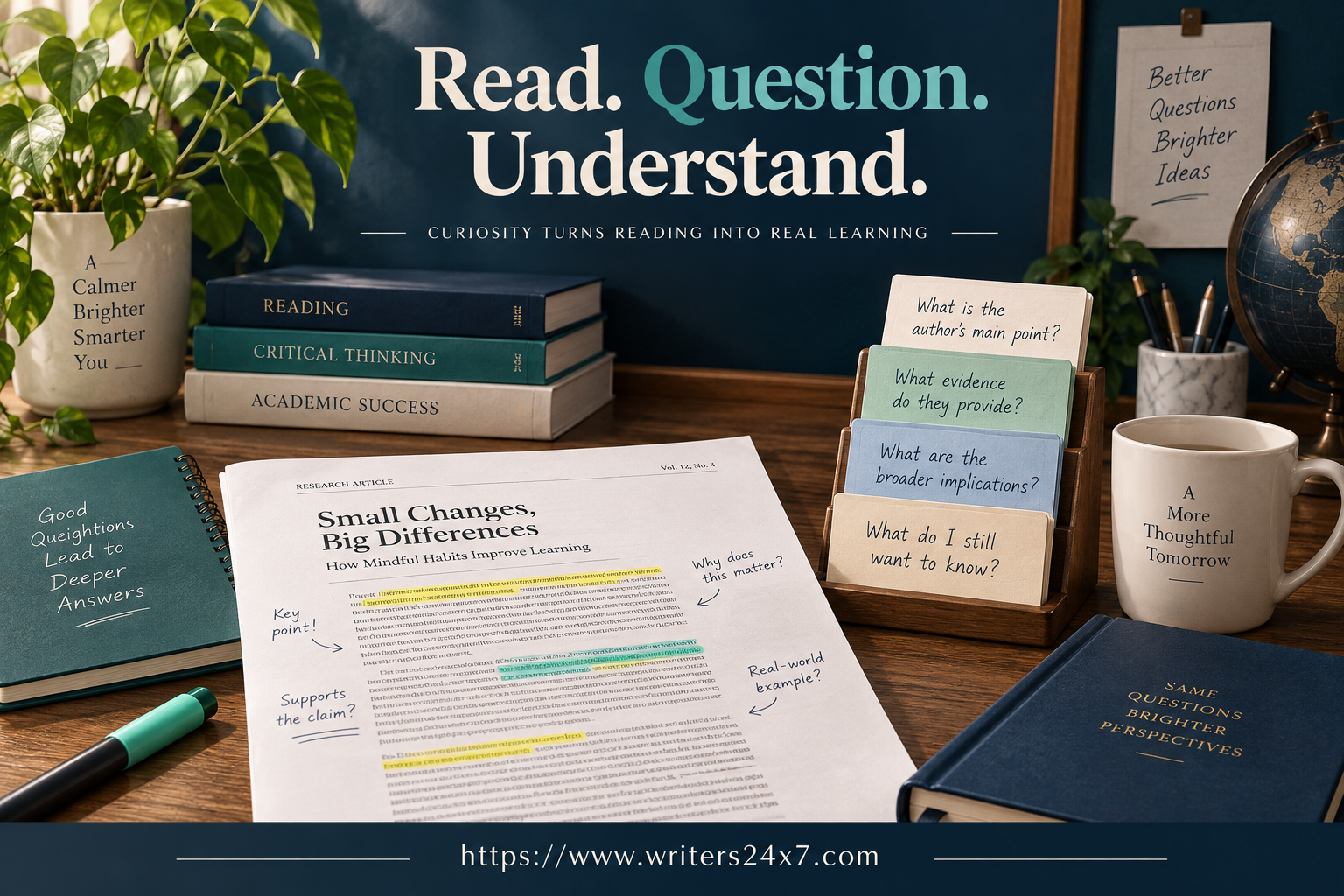
Critical reading means asking how a text develops its claims, what evidence supports them, and where its reasoning may be limited. It does not mean searching for faults in everything you read. A careful reader can recognize a source’s strengths while still questioning its assumptions, scope, and conclusions.
At university, this skill helps you move beyond repeating information. It allows you to compare explanations, select evidence responsibly, and build arguments that respond to the work of others. It also makes research more efficient because you can decide what a source contributes before spending hours taking detailed notes.
This guide offers a practical process for reading academic texts with purpose. The examples are invented to demonstrate reasoning, so they should not be treated as research findings. Use the questions flexibly: a philosophical argument, laboratory report, historical source, and policy document will require different kinds of attention.
1. Begin with a reason for reading
Before opening a source, write one sentence explaining what you need from it. You might need a definition, evidence for a claim, an explanation of a disagreement, or an example of a research method. Having a purpose helps you distinguish useful details from material that is interesting but outside the assignment.
Read the assignment question alongside the source title and abstract or introduction. Identify the overlap. If your essay concerns how students use feedback, a paper about teachers’ workload may offer context without directly answering your central question. Knowing that role prevents you from treating every source as equally important.
Your purpose can change. An article selected for background may contain a limitation that reshapes your argument. Stay open to that possibility, but record the change. Critical reading combines direction with responsiveness; it is neither random browsing nor a search for sentences that confirm a fixed opinion.
2. Preview the structure before reading closely
Look at the title, headings, abstract, introduction, and conclusion. Notice the type of text and its organization. An empirical article often separates methods and results, while a theoretical essay may build its argument through a sequence of conceptual distinctions.
Write a provisional statement of the main claim. Keep it tentative until you read the evidence. This first map helps you understand what each section is trying to accomplish and where the most relevant information is likely to appear.
Previewing is not a substitute for reading the sections you rely on. It is a way to allocate attention. If you plan to cite a finding, read enough of the methods and results to understand what it represents. If you plan to challenge an argument, read its strongest formulation rather than relying on a summary that may omit qualifications.
3. Separate the central claim from supporting points
Ask what the author wants the reader to accept. Then identify the smaller claims that lead toward that conclusion. A text may argue that a teaching practice deserves wider use because it is feasible, well received, and associated with improved outcomes. Those are three different supporting claims.
Map the relationship among them. Does the conclusion require all three to be true? Does one claim receive strong evidence while another rests on an assumption? A simple argument map in your notes can expose gaps that are hard to notice when you read sentence by sentence.
Do not assume that an emphatic statement is the main claim. Authors sometimes use striking examples to introduce a more qualified position. Check the introduction and conclusion together, then compare them with the body of the text. Your eventual summary should represent the argument as a whole.
4. Identify the kind of evidence being used
Evidence can include experimental results, observations, interviews, archival records, textual examples, statistical patterns, or logical reasoning. Its value depends partly on the question. An interview account can illuminate experience, while a controlled comparison may address a different kind of causal question.
Ask whether the evidence supports the specific claim. A survey showing that students prefer a learning activity does not by itself establish that the activity improves learning. Both questions may matter, but they require different outcomes. Distinguishing them prevents you from carrying an unsupported inference into your own work.
Notice when a text moves from evidence to interpretation. That movement is often legitimate and necessary, but it should be visible. Record what the source directly reports and what the author concludes from it. You can then evaluate the reasoning that connects the two.
5. Examine assumptions and definitions
Every argument begins somewhere. Authors make assumptions about what counts as knowledge, which outcomes matter, and how concepts should be defined. Critical reading asks you to identify those starting points rather than treating them as invisible facts.
Pay particular attention to familiar words used technically. Engagement might refer to attendance, participation, emotional investment, or time spent on a task. If two studies use different definitions, their findings may not be directly comparable even when their titles look similar.
Ask whether the definition fits the purpose of the study or argument. You do not need to reject every operational definition because it captures only part of a broad concept. Instead, explain what it includes, what it leaves out, and how that boundary affects the conclusions you can draw.
6. Read methods as part of the argument
In empirical research, methods explain how the evidence was produced. Identify the participants or materials, the setting, the procedure, and the way outcomes were measured or interpreted. These details determine what the results can reasonably support.
For an invented example, imagine a study asking volunteers to report how much they read and how confident they feel about writing. An association between these measures would not automatically prove that reading caused confidence. Other factors could contribute, and self-reports introduce their own interpretive limits.
The point is not to demand a perfect design. Every method has tradeoffs. Ask whether the design is suitable for the research question and whether the conclusions acknowledge its limits. A modest, well-supported conclusion can be more useful than a dramatic statement built on evidence that cannot sustain it.
7. Consider context and perspective
Ask when, where, and for whom the text was produced. A policy argument written for a particular institution may assume resources or priorities that differ from yours. A historical source may reveal its author’s position while leaving other experiences unrecorded.
Consider whose voices or cases are included. Missing perspectives can affect the reach of an argument, but identify the consequence specifically. Instead of saying the text ignores everyone else, explain which group is absent and why that absence matters to the question you are investigating.
Be equally aware of your own position. You may find an argument persuasive because it matches your experience or values. That reaction is worth noticing, but it is not the same as evidence. Ask whether you would apply the same standards to a source that reached the opposite conclusion.
8. Annotate selectively
Highlighting can help you locate important passages, but a page covered in color offers little guidance later. Mark only material connected to your critical reading purpose: the main claim, a key piece of evidence, an important definition, or a limitation that affects interpretation.
Add short notes that record your thinking. Useful labels include claim, evidence, assumption, question, connection, and limitation. A margin note asking how participation was measured may be more valuable than highlighting an entire paragraph about engagement.
Keep copied language clearly marked as a quotation and record its location. Write your own summaries separately. This habit supports accurate referencing and makes it easier to return to the source when you begin drafting. Your notes should preserve the distinction between the author’s words and your response.
9. Compare sources without flattening differences
Once you understand individual texts, compare them around a shared question. Look for agreement, disagreement, different definitions, contrasting methods, and differences in context. A comparison table can help, but the reasoning matters more than the format.
Two sources may appear to disagree because one examines immediate reactions and the other measures long-term behavior. Another pair may use the same outcome but study different populations. Explain these differences before deciding that one source disproves the other.
Sometimes a genuine disagreement remains. Identify the strongest evidence on each side and explain what further information would help resolve it. Critical reading does not require you to eliminate uncertainty. It requires you to describe uncertainty accurately and make a reasoned judgment within it.
10. Turn reading notes into an analytical paragraph
Begin with a point that answers your assignment question. Select the evidence that bears directly on that point, then explain how it supports, qualifies, or challenges your position. This structure keeps your own reasoning visible.
Imagine an essay about participation in seminars. One source might describe students’ reluctance to speak, while another examines how structured preparation changes discussion patterns. An analytical paragraph could compare the social and organizational explanations rather than summarizing each article in isolation.
End by stating the implication for your argument. Perhaps the comparison suggests that confidence alone is an incomplete explanation because the activity design also matters. Make clear which part comes from the sources and which part is your synthesis. Cite the relevant evidence using the required style.
11. A complete critical reading exercise
Consider this invented claim: Students who attend optional writing workshops submit stronger essays, so every student should be required to attend. Start by separating the observation from the recommendation. The first concerns an association; the second proposes a policy.
Ask how essay quality was assessed and whether workshop attendees differed from non-attendees before the workshop. They might have had different motivation, prior attainment, available time, or access to support. These possibilities do not prove the workshop was ineffective, but they complicate a causal interpretation.
Next, examine the recommendation. Even evidence of benefit would leave questions about resources, accessibility, format, and whether compulsory attendance changes the experience. A careful response might support further evaluation or a targeted intervention rather than immediately accepting or rejecting the entire proposal.
This exercise demonstrates the core habit: break a broad statement into claims, identify what each claim requires, and compare those requirements with the evidence available. The resulting judgment can be nuanced without becoming vague.
12. Common barriers to critical reading
One barrier is unfamiliar vocabulary. Create a small glossary and check definitions in reliable course or disciplinary sources. Do not stop for every unfamiliar word on the first pass, but resolve terms that carry the argument before relying on the text.
Another barrier is assuming that published work must be accepted without question. Publication makes a source part of an academic conversation; it does not remove the need to assess its claims. Respectful evaluation is a normal part of scholarship, including when you are still learning the field.
A third barrier is trying to critique too early. If you cannot summarize the author’s position fairly, return to comprehension before evaluation. Otherwise, you may end up challenging an argument the source never made. Understanding and questioning should reinforce each other.
Frequently asked questions
How much time should I spend on each source?
Allocate time according to relevance and difficulty. A central study that supports your main claim deserves closer reading than a source used only for background context. Begin with a preview, decide its likely role, and then choose the level of attention it needs. Avoid applying one rigid time limit to every text.
Does critical writing need a negative tone?
No. You can recognize a useful contribution and identify its boundaries in the same paragraph. Precise evaluation is stronger than dismissive language. Explain what the source does well, what remains uncertain, and why those observations matter to your question.
Can I use questions in my notes?
Yes. Questions are often the most productive notes because they guide further reading. Before submitting an essay, turn the important questions into supported analysis or explicitly identified uncertainties. A draft filled with unanswered rhetorical questions usually needs another stage of reasoning.
Build a repeatable reading routine
For your next source, record its purpose, main claim, evidence, assumptions, limitations, and relevance on one page. Add a short comparison with something else you have read. This creates a compact record that supports both understanding and later writing.
The Purdue OWL research and citation resources can help with the writing and referencing that follow your critical reading. Explore Writers24x7 for academic writing resources, or review the supplied EssayWave link when considering support options. Whatever resources you use, the final interpretation should remain grounded in sources you have actually read.