Table of Contents
ToggleIntroduction to Academic Writing
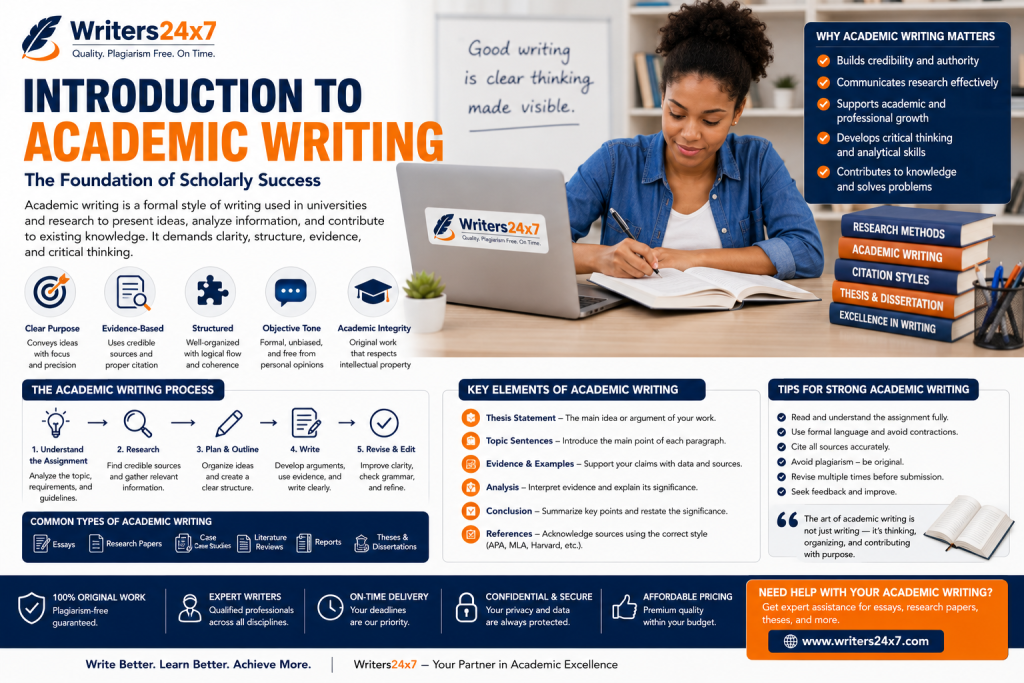
If you are beginning university, college, or postgraduate studies, understanding the introduction to Academic Writing is one of the most valuable academic skills you can develop. Academic writing differs significantly from everyday communication because it emphasizes evidence, objectivity, logical organization, critical thinking, and proper referencing rather than personal opinions or informal language. Whether you are preparing essays, research papers, dissertations, literature reviews, case studies, or reflective journals, mastering the principles taught in an introduction to Academic Writing course forms the foundation for academic success.
Many students assume that writing well simply means using correct grammar and vocabulary. While grammar is important, academic writing requires much more. Students must evaluate scholarly evidence, organize ideas logically, construct persuasive arguments, reference reliable sources accurately, and maintain a formal writing style throughout every assignment.
Universities worldwide expect students to communicate ideas using recognized academic conventions. These standards help ensure clarity, originality, credibility, and consistency across different disciplines. Developing strong academic writing skills early allows students to perform better throughout their educational journey while preparing them for professional careers that demand analytical thinking and effective communication.
Many online articles discussing introduction to Academic Writing provide only brief definitions or generic writing tips. Few explain how students can transition from high school writing to university-level expectations or why academic writing differs from other forms of communication. This guide provides a comprehensive introduction to Academic Writing, explains its essential components, and demonstrates why mastering these skills benefits students across every discipline.
What Existing Articles Miss About Introduction to Academic Writing
After reviewing leading resources covering introduction to Academic Writing, several common weaknesses become apparent.
Many articles define academic writing without explaining why universities require such structured communication. Others provide general advice such as “write clearly” or “support your arguments,” but they rarely demonstrate how students can actually develop these skills through research, critical thinking, and organization.
Another common issue involves unrealistic expectations. Some websites suggest that becoming an excellent academic writer happens quickly. In reality, academic writing improves through consistent reading, regular practice, constructive feedback, and repeated revision.
Several resources also overlook discipline-specific writing requirements. Academic writing in nursing differs from engineering, psychology, business, law, education, or computer science. Although all disciplines value evidence and logical reasoning, each has unique conventions regarding terminology, structure, and referencing.
Finally, many articles fail to emphasize academic integrity. Proper citation, paraphrasing, originality, and ethical research practices are fundamental aspects of every introduction to Academic Writing.
What Is Academic Writing?
A proper introduction to Academic Writing begins by defining the concept itself.
Academic writing is a formal style of communication used by students, researchers, educators, and professionals to present ideas supported by credible evidence. Unlike informal writing, academic writing prioritizes objectivity, logical reasoning, accuracy, and scholarly research.
Its primary purpose is to inform, analyze, evaluate, or persuade using carefully researched information rather than personal opinion.
Academic writing appears in many forms, including:
- Essays
- Research papers
- Literature reviews
- Case studies
- Dissertations
- Theses
- Reports
- Reflective journals
- Research proposals
- Capstone projects
- Discussion posts
- Critical analyses
Regardless of discipline, every assignment builds upon concepts introduced during an introduction to Academic Writing.
Why Academic Writing Matters
Understanding the introduction to Academic Writing helps students develop skills that extend far beyond university assignments.
Strong academic writing improves analytical thinking by encouraging students to examine multiple viewpoints before forming conclusions.
Research skills also improve because students learn how to identify credible academic sources rather than relying on unreliable internet information.
Communication becomes more effective as students organize ideas logically and present evidence clearly.
Problem-solving abilities strengthen because academic writing requires evaluation, comparison, interpretation, and critical analysis.
These skills remain valuable throughout professional careers in healthcare, business, engineering, law, education, public administration, research, and technology.
Characteristics of Academic Writing
Every introduction to Academic Writing introduces several defining characteristics that distinguish academic writing from everyday communication.
Formal Language
Academic writing avoids slang, contractions, and conversational expressions.
Instead of emotional language, writers use precise terminology appropriate for their discipline.
This professional tone improves clarity while maintaining credibility.
Evidence-Based Arguments
One of the most important lessons in an introduction to Academic Writing is supporting every major claim with credible evidence.
Reliable evidence may come from:
- Peer-reviewed journals
- Scholarly books
- Government publications
- Professional organizations
- Research databases
- Systematic reviews
Evidence strengthens arguments while increasing academic credibility.
Objectivity
Academic writing emphasizes balanced analysis rather than personal opinion.
Instead of making unsupported claims, writers evaluate available evidence before drawing conclusions.
Objectivity encourages fairness while reducing personal bias.
Logical Organization
Every academic paper follows a clear structure.
Ideas progress logically from one section to another using headings, paragraphs, transitions, and coherent arguments.
Good organization improves readability while helping readers understand complex information.
Proper Referencing
Referencing remains one of the most important concepts introduced during an introduction to Academic Writing.
Students acknowledge original authors whenever ideas, quotations, statistics, or research findings appear in their assignments.
Proper referencing:
- Prevents plagiarism.
- Demonstrates research.
- Builds credibility.
- Allows readers to verify sources.
Common Types of Academic Writing
Students encounter many forms of academic writing throughout university.
A complete introduction to Academic Writing prepares learners for assignments including:
- Descriptive essays
- Analytical essays
- Argumentative essays
- Research papers
- Case studies
- Literature reviews
- Reflective journals
- Lab reports
- Business reports
- Nursing care plans
- Capstone projects
- Dissertations
- Theses
- Research proposals
Each assignment type develops different academic skills while reinforcing principles of evidence-based writing.
Core Skills Developed Through Academic Writing
Students often underestimate how many transferable skills develop through academic writing.
A comprehensive introduction to Academic Writing strengthens:
- Critical thinking.
- Research.
- Information literacy.
- Problem-solving.
- Communication.
- Time management.
- Organization.
- Analysis.
- Evaluation.
- Academic integrity.
- Professional writing.
These competencies remain valuable long after graduation.
Why Academic Writing Is Challenging
University writing expectations differ significantly from secondary school assignments.
Many students struggle because they must simultaneously learn new referencing styles, academic vocabulary, research techniques, critical analysis, and discipline-specific writing conventions.
Assignments often require students to evaluate multiple scholarly sources rather than summarizing information from a single textbook.
Students also need to develop stronger editing and proofreading skills because university grading often considers grammar, structure, clarity, evidence, and citation accuracy.
Recognizing these challenges early helps students approach academic writing more confidently.
How Writers24x7.com Supports Students
Developing excellent academic writing takes time, practice, and guidance.
Writers24x7.com supports students by providing educational assistance across multiple academic disciplines, including nursing, business, psychology, education, law, engineering, information technology, economics, healthcare, and social sciences.
Students can receive support with:
- Essays
- Research papers
- Literature reviews
- Case studies
- Dissertations
- Research proposals
- Coursework
- Reflective journals
- Discussion posts
- Editing
- Proofreading
- Referencing guidance
Rather than replacing independent learning, these professionally prepared academic resources help students understand assignment expectations, improve writing structure, strengthen research skills, and develop confidence in scholarly communication.
Structure of an Academic Paper
A strong introduction to Academic Writing teaches students that successful academic papers follow a logical structure. Good organization makes ideas easier to understand while demonstrating professionalism and critical thinking.
Most university assignments begin with an introduction that explains the topic, provides background information, and presents a clear thesis statement. The introduction should immediately tell readers what the paper will discuss and why the topic matters.
The body paragraphs develop the main argument. Each paragraph should focus on one key idea supported by scholarly evidence, critical analysis, examples, and appropriate citations. Logical transitions between paragraphs help maintain a smooth flow throughout the assignment.
The conclusion summarizes the major findings without introducing new information. Rather than repeating previous paragraphs word for word, a strong conclusion reinforces the main argument while explaining its significance.
Learning this structure during an introduction to Academic Writing helps students organize assignments more effectively regardless of subject area.
Understanding the Thesis Statement
One of the first concepts introduced during an introduction to Academic Writing is the thesis statement.
A thesis statement communicates the central argument or purpose of an academic paper.
Every section of the assignment should support this central idea.
Weak thesis statements often make broad or vague claims.
Strong thesis statements are:
- Specific.
- Focused.
- Debatable.
- Clear.
- Supported by evidence.
Developing an effective thesis early helps students stay focused while researching and writing.
Research: The Foundation of Academic Writing
Research forms the backbone of academic writing.
An effective introduction to Academic Writing emphasizes that academic arguments should be supported by reliable scholarly evidence rather than unsupported opinions.
Students commonly use:
- Peer-reviewed journal articles.
- Academic textbooks.
- Government publications.
- Professional associations.
- Systematic reviews.
- Conference papers.
- University publications.
Using high-quality sources increases the credibility of every assignment while strengthening critical analysis.
Students should also learn how to distinguish scholarly research from blogs, opinion pieces, and unreliable websites.
Critical Thinking in Academic Writing
Academic writing requires more than summarizing information.
Every introduction to Academic Writing introduces students to critical thinking.
Critical thinking involves:
- Evaluating evidence.
- Comparing viewpoints.
- Identifying strengths and weaknesses.
- Recognizing assumptions.
- Drawing logical conclusions.
Instead of accepting every source as equally valid, students learn to question methodology, credibility, reliability, and relevance.
This analytical approach distinguishes university-level writing from basic descriptive writing.
Referencing Styles Every Student Should Know
Proper citation remains one of the most important topics covered during an introduction to Academic Writing.
Universities use several referencing styles depending on the discipline.
APA (American Psychological Association) is common in nursing, healthcare, psychology, education, and social sciences.
MLA (Modern Language Association) frequently appears in literature and humanities.
Harvard referencing is widely used across many universities internationally.
Chicago style often supports history and some business disciplines.
Although formatting rules differ, every referencing system shares the same purpose:
- Credit original authors.
- Prevent plagiarism.
- Improve credibility.
- Allow readers to verify sources.
Students who master referencing early avoid many common academic penalties.
Academic Integrity
Academic integrity forms the ethical foundation of university education.
A comprehensive introduction to Academic Writing teaches students that original work, honest research, and proper citation are essential academic responsibilities.
Academic integrity includes:
- Proper paraphrasing.
- Accurate citations.
- Honest data reporting.
- Independent thinking.
- Ethical research.
Violations such as plagiarism, contract cheating, falsifying research, or improper citation can lead to serious academic consequences.
Maintaining integrity protects both the student’s academic reputation and the value of university qualifications.
Common Academic Writing Mistakes
Students beginning university often repeat similar writing mistakes.
Understanding these problems during an introduction to Academic Writing helps avoid unnecessary grade reductions.
Common mistakes include:
- Weak thesis statements.
- Poor paragraph organization.
- Informal language.
- Unsupported opinions.
- Missing citations.
- Plagiarism.
- Grammar errors.
- Weak transitions.
- Inconsistent referencing.
- Excessive quotations.
Most of these problems improve through regular writing practice, editing, and constructive feedback.
Editing and Proofreading
Excellent academic papers rarely emerge from a first draft.
Every introduction to Academic Writing emphasizes revision.
Editing focuses on improving:
- Organization.
- Argument development.
- Clarity.
- Flow.
- Evidence.
- Academic tone.
Proofreading focuses on correcting:
- Grammar.
- Spelling.
- Punctuation.
- Formatting.
- Citation accuracy.
Students who dedicate sufficient time to revision consistently produce stronger assignments.
Time Management for Academic Writers
Many students underestimate how much time academic writing requires.
A successful introduction to Academic Writing encourages students to begin assignments early rather than waiting until deadlines approach.
An effective writing schedule includes:
- Reading assignment instructions.
- Researching sources.
- Creating an outline.
- Writing the first draft.
- Revising content.
- Editing.
- Proofreading.
- Final formatting.
Breaking assignments into manageable stages reduces stress while improving overall quality.
Improving Academic Writing Skills
Academic writing improves through consistent practice rather than natural talent alone.
Students can strengthen their writing by:
- Reading scholarly journals regularly.
- Practicing paraphrasing.
- Expanding academic vocabulary.
- Reviewing instructor feedback.
- Studying high-quality academic examples.
- Using university writing centres.
- Learning referencing software.
- Seeking constructive guidance.
Each assignment becomes an opportunity to refine communication, analysis, and research skills.
Technology and Modern Academic Writing
Technology has transformed academic writing significantly.
Students now access digital libraries, citation management software, plagiarism detection tools, grammar checkers, and online academic databases that improve research efficiency.
However, technology should support—not replace—critical thinking.
Successful students still evaluate sources carefully, verify evidence, and construct original arguments based on scholarly research.
A strong introduction to Academic Writing teaches students to combine technological resources with sound academic judgment.
Why Writers24x7.com Helps University Students
Developing professional academic writing takes continuous effort.
Writers24x7.com provides educational support for students across numerous disciplines by helping them better understand assignment expectations, research methods, academic formatting, and scholarly writing techniques.
Students commonly receive guidance with:
- Essays.
- Research papers.
- Literature reviews.
- Case studies.
- Coursework.
- Research proposals.
- Dissertations.
- Editing.
- Proofreading.
- APA formatting.
- MLA formatting.
- Harvard referencing.
These educational resources help students strengthen independent writing while building confidence in university-level communication.
Risks Students Face When Learning Academic Writing
Every introduction to Academic Writing should prepare students for the challenges they are likely to encounter throughout their university education. Academic writing is a skill that develops over time, and most students experience obstacles before becoming confident academic writers.
One common challenge is poor research. Students sometimes rely on blogs, opinion websites, or outdated sources instead of peer-reviewed journals and scholarly publications. This weakens arguments and reduces the credibility of assignments. The best way to mitigate this risk is by using university library databases, Google Scholar, government publications, and reputable academic journals.
Another major risk is plagiarism. Copying text directly without proper citation, paraphrasing incorrectly, or forgetting to reference sources can result in serious academic penalties. Students should always learn the correct citation style required by their institution and review plagiarism policies before submitting assignments.
Time management is another obstacle. Many students underestimate the amount of research, planning, drafting, editing, and proofreading required for quality academic work. Starting assignments early, creating realistic writing schedules, and completing work in stages significantly reduces deadline pressure.
Weak critical thinking also affects assignment quality. Instead of simply describing information, university assignments require students to compare evidence, evaluate research, identify limitations, and develop reasoned conclusions. Regular reading of scholarly literature helps strengthen these analytical skills.
Finally, inconsistent proofreading often leads to avoidable grammar, formatting, and referencing mistakes. Allowing sufficient time to revise assignments before submission improves overall quality and professionalism.
Is Learning Academic Writing Worth It? An Honest Verdict
After completing an introduction to Academic Writing, many students ask whether investing time in developing academic writing skills is worthwhile.
The answer is unquestionably yes.
Academic writing is not simply about completing university assignments. It develops transferable skills that remain valuable throughout professional life. Students improve their ability to research information, evaluate evidence, communicate ideas clearly, solve problems logically, and make informed decisions.
Strong academic writing also increases confidence. Students who understand research methods, citation styles, and structured argument development approach assignments with less anxiety and greater efficiency.
Employers value graduates who can prepare reports, analyze information, present recommendations, and communicate professionally. These abilities often distinguish strong candidates during recruitment and career advancement.
Although mastering academic writing requires consistent practice, the long-term educational and professional benefits make the effort worthwhile.
Frequently Asked Questions
1. What is the purpose of an introduction to Academic Writing?
An introduction to Academic Writing teaches students the foundations of scholarly communication, including research, critical thinking, formal writing style, referencing, academic integrity, and logical organization.
2. Why is academic writing different from everyday writing?
Academic writing emphasizes evidence, objectivity, critical analysis, and formal language. Unlike informal communication, it requires credible research, proper citations, and structured arguments supported by scholarly sources.
3. Which referencing style should students learn first?
The required referencing style depends on the university and discipline. APA is widely used in nursing, psychology, education, and social sciences, while MLA, Harvard, and Chicago are common in other academic fields.
4. How can students improve academic writing quickly?
Students improve by reading scholarly articles, practicing regularly, reviewing instructor feedback, learning referencing techniques, editing carefully, and studying professionally written academic examples.
5. How does Writers24x7.com help students?
Writers24x7.com provides educational support with essays, research papers, literature reviews, dissertations, case studies, editing, proofreading, APA formatting, and academic writing guidance prepared by experienced subject specialists.
Why Choose Writers24x7.com?
Mastering an introduction to Academic Writing requires more than understanding definitions. Students must consistently practice research, organization, analysis, and scholarly communication across multiple assignments.
Writers24x7.com supports students by providing high-quality academic assistance designed to strengthen independent learning rather than replace it.
Students receive guidance with:
- Academic essays
- Research papers
- Literature reviews
- Case studies
- Coursework
- Discussion posts
- Research proposals
- Dissertations
- Editing
- Proofreading
- APA formatting
- MLA formatting
- Harvard referencing
- Chicago style
The platform emphasizes:
- Qualified academic writers
- Original academic work
- Confidential service
- Timely delivery
- Accurate referencing
- Professional editing
- Responsive customer support
Whether you are beginning your introduction to Academic Writing or completing advanced university research, Writers24x7.com provides dependable academic guidance that helps improve writing quality and confidence.
Start today by visiting https://www.writers24x7.com/ to learn more about professional academic writing support.
Conclusion
A comprehensive introduction to Academic Writing provides students with the skills necessary to succeed throughout university and beyond. Academic writing develops much more than grammar and vocabulary. It strengthens research abilities, critical thinking, analytical reasoning, organization, academic integrity, and professional communication.
As students progress through higher education, these competencies become increasingly important for essays, research papers, dissertations, case studies, and professional reports. Consistent practice, careful revision, and responsible use of academic resources help students become confident scholarly writers.
For learners seeking additional guidance, Writers24x7.com offers expert academic support across numerous disciplines. Used responsibly, these educational resources help students understand assignment requirements, improve writing techniques, and build long-term academic success.
Recommended Internal DoFollow Links
- https://www.writers24x7.com/
- https://www.writers24x7.com/blog/
- https://www.writers24x7.com/services/
- https://www.writers24x7.com/contact/
Recommended External DoFollow Links
- https://apastyle.apa.org
- https://owl.purdue.edu
- https://scholar.google.com
- https://eric.ed.gov
- https://www.jstor.org
- https://www.crossref.org
- https://www.elsevier.com
- https://www.ncbi.nlm.nih.gov