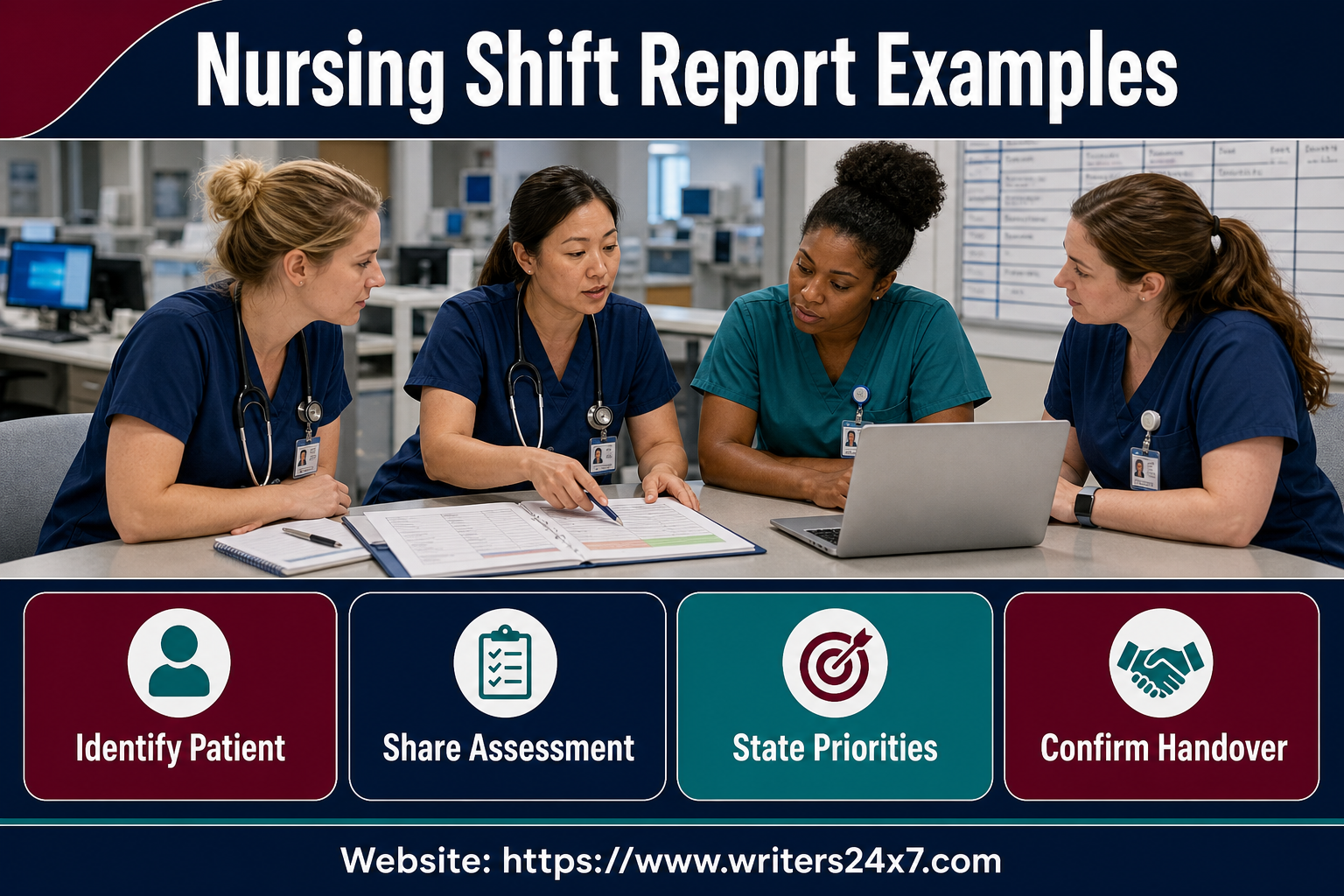
nursing shift report examples can become manageable when you use a clear process. This comprehensive guide explains how to organize a concise, patient-centered nursing handover using a safe communication structure, meet common nursing-school expectations, and present safe, evidence-informed reasoning. It is educational support rather than patient-specific medical advice; always follow your instructor, rubric, clinical supervisor, and local policy.
Strong nursing writing does more than repeat definitions. It identifies important cues, explains relationships, justifies priorities, and communicates conclusions in a way another reader can audit. The method below is designed for nursing students who want a practical structure they can reuse while still adapting every submission to the assigned patient, article, scenario, or learning outcome.
Table of Contents
- Understand the purpose of handover
- Follow organizational policy
- Protect patient confidentiality
- Identify the patient clearly
- Summarize the current situation
- Provide relevant background
- Report priority assessment findings
- Explain recent interventions
- Highlight risks and pending tasks
- State clear recommendations
- Use read-back and clarification
- Avoid common handover errors
- Adapt the report by setting
- Review a complete educational example
1. Understand the purpose of handover for nursing shift report examples
In practice, students should treat Understand the purpose of handover as a short reasoning cycle. State the relevant information, explain why it matters, decide what follows, and check whether the decision is consistent with the case and current guidance. Avoid unsupported certainty. When information is missing, name the limitation and explain what additional assessment, clarification, or research would reduce uncertainty. That level of transparency shows genuine clinical judgment rather than memorized terminology.
A useful quality check for Understand the purpose of handover is to ask four questions: Is the statement specific? Is it supported? Is it relevant to the assigned purpose? Does it lead logically to the next part of the paper? If any answer is no, revise before continuing. Short paragraphs, descriptive headings, accurate terminology, and direct topic sentences improve readability while keeping the discussion academically focused.
For example, a student applying Understand the purpose of handover should not simply list information. The student should organize it into a meaningful pattern, connect that pattern with an appropriate nursing concept, and explain its significance. The final sentence should create a clear bridge to the next step. This makes the reasoning visible to the reader and prevents the paper from becoming a collection of disconnected facts.
Understand the purpose of handover is an essential part of nursing shift report examples because it helps the writer organize a concise, patient-centered nursing handover using a safe communication structure without losing sight of patient safety, assignment instructions, or the evidence supporting each decision. Begin by identifying what the rubric actually asks you to demonstrate. Then separate observations from interpretations, and make every conclusion traceable to a cue, source, calculation, or professional standard. This disciplined approach produces writing that is easier to follow and much easier to evaluate.
Practical checklist
- Match this step to the exact rubric language.
- Support claims with current, relevant evidence.
- Show the connection between information and the nursing decision.
- Check patient safety, clarity, privacy, and professional tone.
2. Follow organizational policy for nursing shift report examples
A useful quality check for Follow organizational policy is to ask four questions: Is the statement specific? Is it supported? Is it relevant to the assigned purpose? Does it lead logically to the next part of the paper? If any answer is no, revise before continuing. Short paragraphs, descriptive headings, accurate terminology, and direct topic sentences improve readability while keeping the discussion academically focused.
For example, a student applying Follow organizational policy should not simply list information. The student should organize it into a meaningful pattern, connect that pattern with an appropriate nursing concept, and explain its significance. The final sentence should create a clear bridge to the next step. This makes the reasoning visible to the reader and prevents the paper from becoming a collection of disconnected facts.
Follow organizational policy is an essential part of nursing shift report examples because it helps the writer organize a concise, patient-centered nursing handover using a safe communication structure without losing sight of patient safety, assignment instructions, or the evidence supporting each decision. Begin by identifying what the rubric actually asks you to demonstrate. Then separate observations from interpretations, and make every conclusion traceable to a cue, source, calculation, or professional standard. This disciplined approach produces writing that is easier to follow and much easier to evaluate.
In practice, students should treat Follow organizational policy as a short reasoning cycle. State the relevant information, explain why it matters, decide what follows, and check whether the decision is consistent with the case and current guidance. Avoid unsupported certainty. When information is missing, name the limitation and explain what additional assessment, clarification, or research would reduce uncertainty. That level of transparency shows genuine clinical judgment rather than memorized terminology.
Practical checklist
- Match this step to the exact rubric language.
- Support claims with current, relevant evidence.
- Show the connection between information and the nursing decision.
- Check patient safety, clarity, privacy, and professional tone.
3. Protect patient confidentiality for nursing shift report examples
For example, a student applying Protect patient confidentiality should not simply list information. The student should organize it into a meaningful pattern, connect that pattern with an appropriate nursing concept, and explain its significance. The final sentence should create a clear bridge to the next step. This makes the reasoning visible to the reader and prevents the paper from becoming a collection of disconnected facts.
Protect patient confidentiality is an essential part of nursing shift report examples because it helps the writer organize a concise, patient-centered nursing handover using a safe communication structure without losing sight of patient safety, assignment instructions, or the evidence supporting each decision. Begin by identifying what the rubric actually asks you to demonstrate. Then separate observations from interpretations, and make every conclusion traceable to a cue, source, calculation, or professional standard. This disciplined approach produces writing that is easier to follow and much easier to evaluate.
In practice, students should treat Protect patient confidentiality as a short reasoning cycle. State the relevant information, explain why it matters, decide what follows, and check whether the decision is consistent with the case and current guidance. Avoid unsupported certainty. When information is missing, name the limitation and explain what additional assessment, clarification, or research would reduce uncertainty. That level of transparency shows genuine clinical judgment rather than memorized terminology.
A useful quality check for Protect patient confidentiality is to ask four questions: Is the statement specific? Is it supported? Is it relevant to the assigned purpose? Does it lead logically to the next part of the paper? If any answer is no, revise before continuing. Short paragraphs, descriptive headings, accurate terminology, and direct topic sentences improve readability while keeping the discussion academically focused.
Practical checklist
- Match this step to the exact rubric language.
- Support claims with current, relevant evidence.
- Show the connection between information and the nursing decision.
- Check patient safety, clarity, privacy, and professional tone.
4. Identify the patient clearly for nursing shift report examples
Identify the patient clearly is an essential part of nursing shift report examples because it helps the writer organize a concise, patient-centered nursing handover using a safe communication structure without losing sight of patient safety, assignment instructions, or the evidence supporting each decision. Begin by identifying what the rubric actually asks you to demonstrate. Then separate observations from interpretations, and make every conclusion traceable to a cue, source, calculation, or professional standard. This disciplined approach produces writing that is easier to follow and much easier to evaluate.
In practice, students should treat Identify the patient clearly as a short reasoning cycle. State the relevant information, explain why it matters, decide what follows, and check whether the decision is consistent with the case and current guidance. Avoid unsupported certainty. When information is missing, name the limitation and explain what additional assessment, clarification, or research would reduce uncertainty. That level of transparency shows genuine clinical judgment rather than memorized terminology.
A useful quality check for Identify the patient clearly is to ask four questions: Is the statement specific? Is it supported? Is it relevant to the assigned purpose? Does it lead logically to the next part of the paper? If any answer is no, revise before continuing. Short paragraphs, descriptive headings, accurate terminology, and direct topic sentences improve readability while keeping the discussion academically focused.
For example, a student applying Identify the patient clearly should not simply list information. The student should organize it into a meaningful pattern, connect that pattern with an appropriate nursing concept, and explain its significance. The final sentence should create a clear bridge to the next step. This makes the reasoning visible to the reader and prevents the paper from becoming a collection of disconnected facts.
Practical checklist
- Match this step to the exact rubric language.
- Support claims with current, relevant evidence.
- Show the connection between information and the nursing decision.
- Check patient safety, clarity, privacy, and professional tone.
5. Summarize the current situation for nursing shift report examples
In practice, students should treat Summarize the current situation as a short reasoning cycle. State the relevant information, explain why it matters, decide what follows, and check whether the decision is consistent with the case and current guidance. Avoid unsupported certainty. When information is missing, name the limitation and explain what additional assessment, clarification, or research would reduce uncertainty. That level of transparency shows genuine clinical judgment rather than memorized terminology.
A useful quality check for Summarize the current situation is to ask four questions: Is the statement specific? Is it supported? Is it relevant to the assigned purpose? Does it lead logically to the next part of the paper? If any answer is no, revise before continuing. Short paragraphs, descriptive headings, accurate terminology, and direct topic sentences improve readability while keeping the discussion academically focused.
For example, a student applying Summarize the current situation should not simply list information. The student should organize it into a meaningful pattern, connect that pattern with an appropriate nursing concept, and explain its significance. The final sentence should create a clear bridge to the next step. This makes the reasoning visible to the reader and prevents the paper from becoming a collection of disconnected facts.
Summarize the current situation is an essential part of nursing shift report examples because it helps the writer organize a concise, patient-centered nursing handover using a safe communication structure without losing sight of patient safety, assignment instructions, or the evidence supporting each decision. Begin by identifying what the rubric actually asks you to demonstrate. Then separate observations from interpretations, and make every conclusion traceable to a cue, source, calculation, or professional standard. This disciplined approach produces writing that is easier to follow and much easier to evaluate.
Practical checklist
- Match this step to the exact rubric language.
- Support claims with current, relevant evidence.
- Show the connection between information and the nursing decision.
- Check patient safety, clarity, privacy, and professional tone.
6. Provide relevant background for nursing shift report examples
A useful quality check for Provide relevant background is to ask four questions: Is the statement specific? Is it supported? Is it relevant to the assigned purpose? Does it lead logically to the next part of the paper? If any answer is no, revise before continuing. Short paragraphs, descriptive headings, accurate terminology, and direct topic sentences improve readability while keeping the discussion academically focused.
For example, a student applying Provide relevant background should not simply list information. The student should organize it into a meaningful pattern, connect that pattern with an appropriate nursing concept, and explain its significance. The final sentence should create a clear bridge to the next step. This makes the reasoning visible to the reader and prevents the paper from becoming a collection of disconnected facts.
Provide relevant background is an essential part of nursing shift report examples because it helps the writer organize a concise, patient-centered nursing handover using a safe communication structure without losing sight of patient safety, assignment instructions, or the evidence supporting each decision. Begin by identifying what the rubric actually asks you to demonstrate. Then separate observations from interpretations, and make every conclusion traceable to a cue, source, calculation, or professional standard. This disciplined approach produces writing that is easier to follow and much easier to evaluate.
In practice, students should treat Provide relevant background as a short reasoning cycle. State the relevant information, explain why it matters, decide what follows, and check whether the decision is consistent with the case and current guidance. Avoid unsupported certainty. When information is missing, name the limitation and explain what additional assessment, clarification, or research would reduce uncertainty. That level of transparency shows genuine clinical judgment rather than memorized terminology.
Practical checklist
- Match this step to the exact rubric language.
- Support claims with current, relevant evidence.
- Show the connection between information and the nursing decision.
- Check patient safety, clarity, privacy, and professional tone.
7. Report priority assessment findings for nursing shift report examples
For example, a student applying Report priority assessment findings should not simply list information. The student should organize it into a meaningful pattern, connect that pattern with an appropriate nursing concept, and explain its significance. The final sentence should create a clear bridge to the next step. This makes the reasoning visible to the reader and prevents the paper from becoming a collection of disconnected facts.
Report priority assessment findings is an essential part of nursing shift report examples because it helps the writer organize a concise, patient-centered nursing handover using a safe communication structure without losing sight of patient safety, assignment instructions, or the evidence supporting each decision. Begin by identifying what the rubric actually asks you to demonstrate. Then separate observations from interpretations, and make every conclusion traceable to a cue, source, calculation, or professional standard. This disciplined approach produces writing that is easier to follow and much easier to evaluate.
In practice, students should treat Report priority assessment findings as a short reasoning cycle. State the relevant information, explain why it matters, decide what follows, and check whether the decision is consistent with the case and current guidance. Avoid unsupported certainty. When information is missing, name the limitation and explain what additional assessment, clarification, or research would reduce uncertainty. That level of transparency shows genuine clinical judgment rather than memorized terminology.
A useful quality check for Report priority assessment findings is to ask four questions: Is the statement specific? Is it supported? Is it relevant to the assigned purpose? Does it lead logically to the next part of the paper? If any answer is no, revise before continuing. Short paragraphs, descriptive headings, accurate terminology, and direct topic sentences improve readability while keeping the discussion academically focused.
Practical checklist
- Match this step to the exact rubric language.
- Support claims with current, relevant evidence.
- Show the connection between information and the nursing decision.
- Check patient safety, clarity, privacy, and professional tone.
8. Explain recent interventions for nursing shift report examples
Explain recent interventions is an essential part of nursing shift report examples because it helps the writer organize a concise, patient-centered nursing handover using a safe communication structure without losing sight of patient safety, assignment instructions, or the evidence supporting each decision. Begin by identifying what the rubric actually asks you to demonstrate. Then separate observations from interpretations, and make every conclusion traceable to a cue, source, calculation, or professional standard. This disciplined approach produces writing that is easier to follow and much easier to evaluate.
In practice, students should treat Explain recent interventions as a short reasoning cycle. State the relevant information, explain why it matters, decide what follows, and check whether the decision is consistent with the case and current guidance. Avoid unsupported certainty. When information is missing, name the limitation and explain what additional assessment, clarification, or research would reduce uncertainty. That level of transparency shows genuine clinical judgment rather than memorized terminology.
A useful quality check for Explain recent interventions is to ask four questions: Is the statement specific? Is it supported? Is it relevant to the assigned purpose? Does it lead logically to the next part of the paper? If any answer is no, revise before continuing. Short paragraphs, descriptive headings, accurate terminology, and direct topic sentences improve readability while keeping the discussion academically focused.
For example, a student applying Explain recent interventions should not simply list information. The student should organize it into a meaningful pattern, connect that pattern with an appropriate nursing concept, and explain its significance. The final sentence should create a clear bridge to the next step. This makes the reasoning visible to the reader and prevents the paper from becoming a collection of disconnected facts.
Practical checklist
- Match this step to the exact rubric language.
- Support claims with current, relevant evidence.
- Show the connection between information and the nursing decision.
- Check patient safety, clarity, privacy, and professional tone.
9. Highlight risks and pending tasks for nursing shift report examples
In practice, students should treat Highlight risks and pending tasks as a short reasoning cycle. State the relevant information, explain why it matters, decide what follows, and check whether the decision is consistent with the case and current guidance. Avoid unsupported certainty. When information is missing, name the limitation and explain what additional assessment, clarification, or research would reduce uncertainty. That level of transparency shows genuine clinical judgment rather than memorized terminology.
A useful quality check for Highlight risks and pending tasks is to ask four questions: Is the statement specific? Is it supported? Is it relevant to the assigned purpose? Does it lead logically to the next part of the paper? If any answer is no, revise before continuing. Short paragraphs, descriptive headings, accurate terminology, and direct topic sentences improve readability while keeping the discussion academically focused.
For example, a student applying Highlight risks and pending tasks should not simply list information. The student should organize it into a meaningful pattern, connect that pattern with an appropriate nursing concept, and explain its significance. The final sentence should create a clear bridge to the next step. This makes the reasoning visible to the reader and prevents the paper from becoming a collection of disconnected facts.
Highlight risks and pending tasks is an essential part of nursing shift report examples because it helps the writer organize a concise, patient-centered nursing handover using a safe communication structure without losing sight of patient safety, assignment instructions, or the evidence supporting each decision. Begin by identifying what the rubric actually asks you to demonstrate. Then separate observations from interpretations, and make every conclusion traceable to a cue, source, calculation, or professional standard. This disciplined approach produces writing that is easier to follow and much easier to evaluate.
Practical checklist
- Match this step to the exact rubric language.
- Support claims with current, relevant evidence.
- Show the connection between information and the nursing decision.
- Check patient safety, clarity, privacy, and professional tone.
10. State clear recommendations for nursing shift report examples
A useful quality check for State clear recommendations is to ask four questions: Is the statement specific? Is it supported? Is it relevant to the assigned purpose? Does it lead logically to the next part of the paper? If any answer is no, revise before continuing. Short paragraphs, descriptive headings, accurate terminology, and direct topic sentences improve readability while keeping the discussion academically focused.
For example, a student applying State clear recommendations should not simply list information. The student should organize it into a meaningful pattern, connect that pattern with an appropriate nursing concept, and explain its significance. The final sentence should create a clear bridge to the next step. This makes the reasoning visible to the reader and prevents the paper from becoming a collection of disconnected facts.
State clear recommendations is an essential part of nursing shift report examples because it helps the writer organize a concise, patient-centered nursing handover using a safe communication structure without losing sight of patient safety, assignment instructions, or the evidence supporting each decision. Begin by identifying what the rubric actually asks you to demonstrate. Then separate observations from interpretations, and make every conclusion traceable to a cue, source, calculation, or professional standard. This disciplined approach produces writing that is easier to follow and much easier to evaluate.
In practice, students should treat State clear recommendations as a short reasoning cycle. State the relevant information, explain why it matters, decide what follows, and check whether the decision is consistent with the case and current guidance. Avoid unsupported certainty. When information is missing, name the limitation and explain what additional assessment, clarification, or research would reduce uncertainty. That level of transparency shows genuine clinical judgment rather than memorized terminology.
Practical checklist
- Match this step to the exact rubric language.
- Support claims with current, relevant evidence.
- Show the connection between information and the nursing decision.
- Check patient safety, clarity, privacy, and professional tone.
11. Use read-back and clarification for nursing shift report examples
For example, a student applying Use read-back and clarification should not simply list information. The student should organize it into a meaningful pattern, connect that pattern with an appropriate nursing concept, and explain its significance. The final sentence should create a clear bridge to the next step. This makes the reasoning visible to the reader and prevents the paper from becoming a collection of disconnected facts.
Use read-back and clarification is an essential part of nursing shift report examples because it helps the writer organize a concise, patient-centered nursing handover using a safe communication structure without losing sight of patient safety, assignment instructions, or the evidence supporting each decision. Begin by identifying what the rubric actually asks you to demonstrate. Then separate observations from interpretations, and make every conclusion traceable to a cue, source, calculation, or professional standard. This disciplined approach produces writing that is easier to follow and much easier to evaluate.
In practice, students should treat Use read-back and clarification as a short reasoning cycle. State the relevant information, explain why it matters, decide what follows, and check whether the decision is consistent with the case and current guidance. Avoid unsupported certainty. When information is missing, name the limitation and explain what additional assessment, clarification, or research would reduce uncertainty. That level of transparency shows genuine clinical judgment rather than memorized terminology.
A useful quality check for Use read-back and clarification is to ask four questions: Is the statement specific? Is it supported? Is it relevant to the assigned purpose? Does it lead logically to the next part of the paper? If any answer is no, revise before continuing. Short paragraphs, descriptive headings, accurate terminology, and direct topic sentences improve readability while keeping the discussion academically focused.
Practical checklist
- Match this step to the exact rubric language.
- Support claims with current, relevant evidence.
- Show the connection between information and the nursing decision.
- Check patient safety, clarity, privacy, and professional tone.
12. Avoid common handover errors for nursing shift report examples
Avoid common handover errors is an essential part of nursing shift report examples because it helps the writer organize a concise, patient-centered nursing handover using a safe communication structure without losing sight of patient safety, assignment instructions, or the evidence supporting each decision. Begin by identifying what the rubric actually asks you to demonstrate. Then separate observations from interpretations, and make every conclusion traceable to a cue, source, calculation, or professional standard. This disciplined approach produces writing that is easier to follow and much easier to evaluate.
In practice, students should treat Avoid common handover errors as a short reasoning cycle. State the relevant information, explain why it matters, decide what follows, and check whether the decision is consistent with the case and current guidance. Avoid unsupported certainty. When information is missing, name the limitation and explain what additional assessment, clarification, or research would reduce uncertainty. That level of transparency shows genuine clinical judgment rather than memorized terminology.
A useful quality check for Avoid common handover errors is to ask four questions: Is the statement specific? Is it supported? Is it relevant to the assigned purpose? Does it lead logically to the next part of the paper? If any answer is no, revise before continuing. Short paragraphs, descriptive headings, accurate terminology, and direct topic sentences improve readability while keeping the discussion academically focused.
For example, a student applying Avoid common handover errors should not simply list information. The student should organize it into a meaningful pattern, connect that pattern with an appropriate nursing concept, and explain its significance. The final sentence should create a clear bridge to the next step. This makes the reasoning visible to the reader and prevents the paper from becoming a collection of disconnected facts.
Practical checklist
- Match this step to the exact rubric language.
- Support claims with current, relevant evidence.
- Show the connection between information and the nursing decision.
- Check patient safety, clarity, privacy, and professional tone.
13. Adapt the report by setting for nursing shift report examples
In practice, students should treat Adapt the report by setting as a short reasoning cycle. State the relevant information, explain why it matters, decide what follows, and check whether the decision is consistent with the case and current guidance. Avoid unsupported certainty. When information is missing, name the limitation and explain what additional assessment, clarification, or research would reduce uncertainty. That level of transparency shows genuine clinical judgment rather than memorized terminology.
A useful quality check for Adapt the report by setting is to ask four questions: Is the statement specific? Is it supported? Is it relevant to the assigned purpose? Does it lead logically to the next part of the paper? If any answer is no, revise before continuing. Short paragraphs, descriptive headings, accurate terminology, and direct topic sentences improve readability while keeping the discussion academically focused.
For example, a student applying Adapt the report by setting should not simply list information. The student should organize it into a meaningful pattern, connect that pattern with an appropriate nursing concept, and explain its significance. The final sentence should create a clear bridge to the next step. This makes the reasoning visible to the reader and prevents the paper from becoming a collection of disconnected facts.
Adapt the report by setting is an essential part of nursing shift report examples because it helps the writer organize a concise, patient-centered nursing handover using a safe communication structure without losing sight of patient safety, assignment instructions, or the evidence supporting each decision. Begin by identifying what the rubric actually asks you to demonstrate. Then separate observations from interpretations, and make every conclusion traceable to a cue, source, calculation, or professional standard. This disciplined approach produces writing that is easier to follow and much easier to evaluate.
Practical checklist
- Match this step to the exact rubric language.
- Support claims with current, relevant evidence.
- Show the connection between information and the nursing decision.
- Check patient safety, clarity, privacy, and professional tone.
14. Review a complete educational example for nursing shift report examples
A useful quality check for Review a complete educational example is to ask four questions: Is the statement specific? Is it supported? Is it relevant to the assigned purpose? Does it lead logically to the next part of the paper? If any answer is no, revise before continuing. Short paragraphs, descriptive headings, accurate terminology, and direct topic sentences improve readability while keeping the discussion academically focused.
For example, a student applying Review a complete educational example should not simply list information. The student should organize it into a meaningful pattern, connect that pattern with an appropriate nursing concept, and explain its significance. The final sentence should create a clear bridge to the next step. This makes the reasoning visible to the reader and prevents the paper from becoming a collection of disconnected facts.
Review a complete educational example is an essential part of nursing shift report examples because it helps the writer organize a concise, patient-centered nursing handover using a safe communication structure without losing sight of patient safety, assignment instructions, or the evidence supporting each decision. Begin by identifying what the rubric actually asks you to demonstrate. Then separate observations from interpretations, and make every conclusion traceable to a cue, source, calculation, or professional standard. This disciplined approach produces writing that is easier to follow and much easier to evaluate.
In practice, students should treat Review a complete educational example as a short reasoning cycle. State the relevant information, explain why it matters, decide what follows, and check whether the decision is consistent with the case and current guidance. Avoid unsupported certainty. When information is missing, name the limitation and explain what additional assessment, clarification, or research would reduce uncertainty. That level of transparency shows genuine clinical judgment rather than memorized terminology.
Practical checklist
- Match this step to the exact rubric language.
- Support claims with current, relevant evidence.
- Show the connection between information and the nursing decision.
- Check patient safety, clarity, privacy, and professional tone.
Evidence, internal resources, and further reading
Use recent peer-reviewed evidence and the sources required by your course. Helpful authoritative starting points include the National Council of State Boards of Nursing, PubMed, and the Centers for Disease Control and Prevention. Confirm publication dates and never use a general webpage to replace current clinical policy.
For related NurseHomeworks support, review our nursing care plan guide, evidence-based practice nursing paper guide, and dosage calculation practice resource. These internal links can help you connect planning, evidence appraisal, calculations, and academic presentation.
Students seeking other forms of academic support can also visit NursingHomework academic support, Dissertation Flow, Writers24x7, and PowerPoint Presentation Help. These are external partner links, so review each service and your institution’s academic-integrity policy before using outside assistance.
Frequently asked questions about nursing shift report examples
How long should the assignment be?
Follow the current rubric first because requirements vary. Use enough detail and evidence to answer every criterion directly, keep the structure easy to scan, and remove material that does not advance the purpose. A template may organize the work, but the reasoning, examples, sources, and wording must be tailored to the specific assignment.
How many references should I use?
Follow the current rubric first because requirements vary. Use enough detail and evidence to answer every criterion directly, keep the structure easy to scan, and remove material that does not advance the purpose. A template may organize the work, but the reasoning, examples, sources, and wording must be tailored to the specific assignment.
Can I use a template?
Follow the current rubric first because requirements vary. Use enough detail and evidence to answer every criterion directly, keep the structure easy to scan, and remove material that does not advance the purpose. A template may organize the work, but the reasoning, examples, sources, and wording must be tailored to the specific assignment.
How do I improve academic tone?
Follow the current rubric first because requirements vary. Use enough detail and evidence to answer every criterion directly, keep the structure easy to scan, and remove material that does not advance the purpose. A template may organize the work, but the reasoning, examples, sources, and wording must be tailored to the specific assignment.
What should I check before submitting?
Follow the current rubric first because requirements vary. Use enough detail and evidence to answer every criterion directly, keep the structure easy to scan, and remove material that does not advance the purpose. A template may organize the work, but the reasoning, examples, sources, and wording must be tailored to the specific assignment.
Final submission checklist
- The focus and purpose are clear in the introduction.
- Every major claim is explained and supported.
- Headings follow a logical sequence.
- Paragraphs are concise and connected.
- Internal and authoritative external links are included.
- Citations and references match the required style.
- Patient details are de-identified.
- The conclusion answers the assignment purpose.
If you want structured academic support with nursing shift report examples, email NurseHomeworks at support@nursehomeworks.com. We can help you understand a rubric, organize research, review reasoning, and improve presentation while you remain responsible for your own learning and final submission.
Helpful Nursing and Academic Resources
Related Writers24x7 Nursing Guides
- Nursing Discussion Post Examples: 10 Powerful Steps for Better Replies
- Pathophysiology Concept Map: 12 Proven Steps for Nursing Students
- Nursing Change Project Proposal: 11 Powerful Steps That Work
- Nursing Literature Review Topics: 50 Strong Ideas and 10 Easy Steps