Table of Contents
ToggleAcademic Writing Style Guidelines
University assignments require much more than simply answering questions. Whether you are writing an essay, research paper, literature review, dissertation, case study, or coursework, your work must follow accepted academic writing style guidelines. These guidelines help students communicate ideas clearly, present logical arguments, and demonstrate critical thinking while maintaining academic integrity.
Many students possess excellent ideas but lose marks because their papers lack proper structure, consistent formatting, or an appropriate academic tone. Learning academic writing style guidelines allows students to organize information professionally, use credible evidence effectively, and meet university expectations regardless of their field of study.
Unlike creative or conversational writing, academic writing emphasizes objectivity, precision, clarity, and evidence-based reasoning. Every statement should contribute to answering the research question while being supported by reliable academic sources. Universities value analytical thinking far more than complicated vocabulary or lengthy sentences.
At Writers24x7, we regularly assist students with essays, dissertations, coursework, research papers, editing, proofreading, and assignment guidance. Through years of supporting university students across different disciplines, we have identified the writing practices that consistently lead to stronger academic performance.
If you are looking to improve your essays, coursework, or research projects, understanding these academic writing style guidelines is one of the best investments you can make in your academic success.
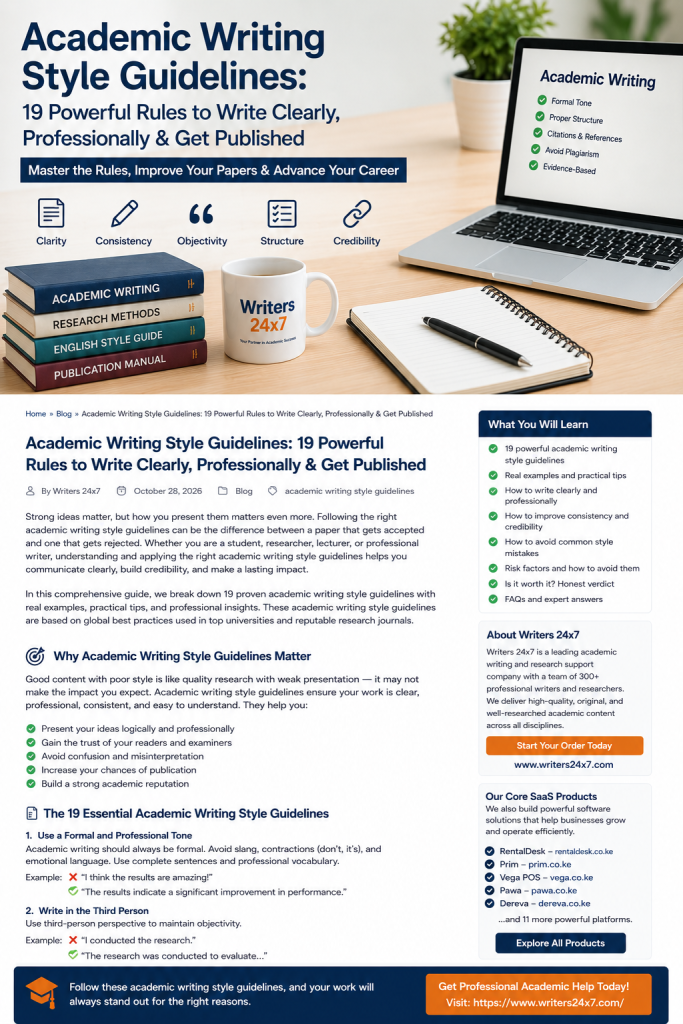
What Are Academic Writing Style Guidelines?
Academic writing style guidelines are the accepted rules and conventions used to prepare scholarly documents. They govern how ideas should be presented, how evidence should be cited, the tone writers should use, and how papers should be organized.
These guidelines exist because academic writing aims to communicate knowledge objectively and professionally. Readers should be able to understand your argument without being distracted by poor grammar, inconsistent formatting, emotional language, or unsupported opinions.
Although different institutions may require citation styles such as APA, MLA, Harvard, Chicago, or IEEE, the underlying principles remain similar. Effective academic writing is logical, structured, evidence-based, and reader-focused.
Students should also understand that academic style is not about making writing unnecessarily complicated. Instead, it focuses on expressing ideas accurately using formal language and supporting every significant claim with credible evidence.
Mastering these academic writing style guidelines helps students produce work that meets university expectations while improving confidence during the writing process.
Why Academic Writing Style Guidelines Matter
Some students believe content alone determines their grades. While strong research is essential, presentation also influences how lecturers evaluate assignments.
Following accepted academic writing style guidelines demonstrates professionalism and attention to detail. A well-structured paper is easier to read, allowing markers to focus on your ideas rather than being distracted by organizational problems.
Academic style also strengthens credibility. When sources are cited correctly and arguments are presented logically, readers are more likely to trust your conclusions.
Another important benefit involves reducing plagiarism risks. Proper referencing ensures that original authors receive appropriate credit while protecting students from academic misconduct.
Beyond university, these writing skills remain valuable throughout professional careers. Reports, proposals, policy documents, technical manuals, business plans, and research publications all require clear and structured communication.
Learning academic writing style guidelines therefore supports both academic achievement and long-term career development.
Key Features of Academic Writing
Every successful academic paper shares several important characteristics.
First, academic writing should always be objective. Personal emotions, unsupported opinions, and exaggerated claims should be avoided. Instead, arguments should rely on verifiable evidence from reputable academic sources.
Second, clarity is essential. Readers should understand each sentence immediately without interpreting ambiguous language.
Third, organization plays a major role. Every section should contribute toward answering the assignment question while maintaining logical progression between ideas.
Another defining characteristic involves evidence-based discussion. Academic writers support their arguments using peer-reviewed journal articles, books, government reports, conference proceedings, and reputable institutional publications.
Consistency is equally important. Formatting, terminology, headings, references, and writing style should remain uniform throughout the paper.
Applying these academic writing style guidelines consistently helps create professional, coherent assignments.
Understanding Formal Academic Language
Formal language distinguishes academic writing from everyday communication.
Instead of conversational expressions, academic writers use precise vocabulary that communicates ideas objectively.
For example, rather than writing:
“I think online learning is awesome.”
A stronger academic sentence would state:
“Research indicates that online learning has improved educational accessibility while presenting challenges related to student engagement.”
Notice that the second sentence relies on evidence rather than personal opinion.
Effective academic writing style guidelines also recommend avoiding contractions such as “don’t,” “can’t,” and “won’t.” Instead, use their complete forms: “do not,” “cannot,” and “will not.”
Similarly, avoid slang, informal abbreviations, and emotionally charged language unless directly quoting participants in qualitative research.
Writers should also avoid unnecessary repetition. If one sentence adequately communicates an idea, additional sentences should contribute new information rather than restating previous points.
Using formal language improves professionalism while making arguments more persuasive.
How to Structure Academic Papers
Strong organization forms the foundation of excellent academic writing.
Regardless of discipline, most assignments follow a logical structure.
The introduction introduces the topic, provides background information, identifies the research problem, presents the thesis statement, and outlines the paper’s objectives.
The body paragraphs develop the argument systematically. Each paragraph focuses on one central idea supported by evidence and critical analysis.
Finally, the conclusion summarizes the major findings without introducing entirely new arguments.
Planning before writing is one of the most effective academic writing style guidelines because it prevents ideas from becoming disorganized later.
Many successful students create outlines before drafting.
A simple outline identifies major headings, supporting arguments, relevant evidence, and transitions between sections.
This planning process reduces unnecessary revisions while improving overall coherence.
Developing a Strong Thesis Statement
Every academic paper requires a clear central argument.
The thesis statement tells readers exactly what the paper intends to demonstrate.
Weak thesis statements are often vague.
Example:
Social media affects education.
A stronger thesis might state:
Social media has transformed higher education by improving collaboration, increasing access to educational resources, and creating new opportunities for peer learning while introducing challenges related to distraction and misinformation.
The second example clearly establishes the direction of the discussion.
One of the most valuable academic writing style guidelines involves reviewing your thesis after completing the first draft.
As your research develops, you may refine your argument.
Updating the thesis ensures consistency between the introduction and the remainder of the assignment.
Paragraph Writing Guidelines
Well-developed paragraphs improve readability and logical flow.
Each paragraph should begin with a topic sentence introducing its central idea.
This should be followed by supporting evidence from credible academic sources.
Next comes analysis.
Rather than merely presenting quotations, explain why the evidence supports your argument.
Compare different viewpoints, evaluate strengths and weaknesses, and demonstrate independent thinking.
Finally, conclude each paragraph by linking naturally to the next section.
This creates smooth transitions throughout the assignment.
Among all academic writing style guidelines, effective paragraph development has one of the greatest impacts on readability because it helps readers follow complex arguments without confusion.
Short paragraphs also improve readability, especially in online academic resources and professional publications.
Using Evidence and Sources Correctly
Academic writing depends on evidence.
However, effective writers understand that simply adding quotations does not strengthen an argument.
Instead, introduce each source carefully.
Explain its relevance.
Interpret its findings.
Discuss its implications.
Connect it directly to your thesis.
This process demonstrates analytical thinking rather than simple description.
High-quality sources include peer-reviewed journals, university publications, academic books, government reports, and reputable research organizations.
Whenever multiple studies examine the same topic, compare their conclusions instead of discussing each individually.
Doing so shows deeper understanding of the literature.
Another essential component of academic writing style guidelines involves accurate referencing.
Every borrowed idea, quotation, statistic, or paraphrased argument should receive appropriate citation according to your institution’s required referencing style.
Proper citation protects academic integrity while allowing readers to verify your evidence independently.
Common Academic Style Mistakes to Avoid
Even well-researched assignments lose marks because of avoidable writing mistakes.
One common issue is using overly complex sentences that make ideas difficult to understand.
Another frequent mistake involves switching between formal and informal language within the same paper.
Students also sometimes rely too heavily on direct quotations instead of providing their own analysis.
Other problems include inconsistent referencing, weak paragraph organization, unsupported claims, grammatical errors, and failing to answer the assignment question directly.
Fortunately, these issues can be corrected through careful planning, editing, proofreading, and consistent application of academic writing style guidelines.
Professional editing services can also identify problems that students may overlook before submitting their work.
Editing and Proofreading: Essential Academic Writing Style Guidelines
One of the most overlooked academic writing style guidelines is allocating enough time for editing and proofreading. Many students complete an assignment only a few hours before the deadline and submit it without reviewing their work. While the research may be excellent, small mistakes in grammar, punctuation, formatting, or referencing can reduce the overall quality of the paper.
Editing should focus on improving clarity, coherence, and logical flow. Read each paragraph carefully and ask yourself whether it contributes directly to your thesis statement. Remove repetitive sentences, replace vague wording with precise language, and ensure every paragraph transitions smoothly to the next.
Proofreading, on the other hand, focuses on technical accuracy. Check spelling, punctuation, page numbering, headings, citation style, and formatting consistency. Reading your paper aloud is a simple but highly effective way to identify awkward sentences that may not be obvious during silent reading.
Students who need additional support can use the professional editing and proofreading services available through Writers24x7 at https://www.writers24x7.com/, where experienced academic editors help improve grammar, structure, formatting, and overall readability. Likewise, the Coursework Writing Help Online guide at https://www.writers24x7.com/blog/course-writing-help-online/ provides additional advice for students preparing university assignments.
Referencing According to Academic Writing Style Guidelines
Correct referencing is one of the most important academic writing style guidelines because it demonstrates academic honesty and allows readers to verify your sources.
Different universities require different citation styles, including APA, MLA, Harvard, Chicago, and IEEE. Regardless of the required format, consistency is essential throughout the assignment.
Useful resources for learning proper citation include the Purdue OWL website at https://owl.purdue.edu/owl/, the official APA Style website at https://apastyle.apa.org/, and Google Scholar at https://scholar.google.com/ for locating peer-reviewed research.
Students should cite every quotation, paraphrased idea, statistic, figure, or concept borrowed from another author. Failing to do so may result in plagiarism allegations, even when the omission is accidental.
Following proper academic writing style guidelines ensures your work remains credible while demonstrating respect for the original researchers whose work supports your arguments.
Critical Thinking and Academic Writing Style Guidelines
Excellent academic writing goes beyond summarizing information. Universities expect students to evaluate evidence, compare different viewpoints, identify limitations, and explain why one argument is more convincing than another.
For example, instead of writing that online education is beneficial, discuss both its strengths and weaknesses before reaching a balanced conclusion. This demonstrates analytical thinking rather than simply repeating information from textbooks.
Applying academic writing style guidelines means asking important questions while researching:
- Is the evidence reliable?
- Who conducted the research?
- Are there conflicting findings?
- What limitations exist?
- Does the evidence answer the research question?
Critical thinking strengthens every assignment because it shows lecturers that you understand the subject instead of merely describing it.
Time Management for Better Academic Writing
Poor time management is one of the leading causes of weak academic assignments. Students who begin writing the night before the deadline often struggle to conduct sufficient research, organize their ideas, or edit their work properly.
One of the simplest academic writing style guidelines is creating a realistic writing schedule.
Begin by reading the assignment instructions carefully.
Next, spend adequate time collecting credible sources.
Prepare an outline before drafting.
Write the first draft without worrying about perfection.
Finally, reserve enough time for editing and proofreading.
Breaking the assignment into smaller stages reduces stress while improving overall quality.
Students preparing dissertations, research proposals, or lengthy coursework can also benefit from the academic support available through Writers24x7, which offers guidance on planning, research, editing, and formatting.
Using Academic Writing Services Responsibly
There are situations where students genuinely require professional assistance.
Complex dissertations, nursing research projects, programming assignments, engineering reports, and statistical analyses often require specialized knowledge.
Using professional academic support responsibly does not mean submitting someone else’s work without understanding it. Instead, students should use these services to improve their understanding, receive constructive feedback, and strengthen their writing skills.
At Writers24x7, students can receive assistance with essays, dissertations, literature reviews, research proposals, editing, proofreading, case studies, and coursework. Additional academic resources are available through the website’s blog and student support pages.
Students interested in improving their research skills may also benefit from resources provided by Google Scholar, Purdue OWL, and the APA Style website, all of which complement the academic writing style guidelines discussed throughout this guide.
Risk Section: What Can Go Wrong?
Even when students understand academic writing style guidelines, several challenges may affect the quality of their assignments.
The first risk is plagiarism. Copying text from books, journal articles, or websites without proper citation can result in serious academic penalties. Always paraphrase carefully and acknowledge every source using the required referencing style.
Another common problem is relying on unreliable online sources. Blogs, anonymous websites, and outdated articles may contain inaccurate information. Whenever possible, prioritize peer-reviewed journals, university publications, government reports, and reputable academic organizations.
Poor organization is another frequent issue. Assignments that jump randomly between ideas confuse readers and weaken arguments. Creating a detailed outline before writing helps maintain logical flow.
Students should also avoid submitting assignments without proofreading. Minor grammatical errors, formatting inconsistencies, and citation mistakes often reduce marks despite strong research.
These risks can be minimized by planning ahead, following accepted academic writing style guidelines, proofreading thoroughly, and seeking professional feedback whenever necessary.
Is Following Academic Writing Style Guidelines Worth It?
Yes.
Learning academic writing style guidelines requires time and consistent practice, but the benefits extend far beyond university.
Students who write clearly, organize ideas logically, and support arguments with credible evidence often perform better academically. These same skills remain valuable throughout professional careers in business, healthcare, law, engineering, education, public policy, and research.
Employers value graduates who can prepare reports, proposals, technical documentation, and research papers using structured, professional communication.
Rather than viewing academic writing as a university requirement, students should consider it a lifelong skill that improves analytical thinking and effective communication.
Frequently Asked Questions
1. What are academic writing style guidelines?
Academic writing style guidelines are standardized rules that govern the structure, language, formatting, referencing, and presentation of scholarly writing to ensure clarity, consistency, and academic integrity.
2. Why are academic writing style guidelines important?
They help students communicate ideas effectively, organize arguments logically, cite sources correctly, avoid plagiarism, and meet university marking criteria.
3. Which citation style should I use?
Your university or lecturer will specify whether to use APA, MLA, Harvard, Chicago, IEEE, or another referencing style. Always follow the required format consistently throughout your assignment.
4. Can Writers24x7 help with dissertations and research papers?
Yes. Writers24x7 provides academic support for essays, dissertations, coursework, literature reviews, research proposals, editing, proofreading, nursing assignments, programming projects, and many other university tasks. Learn more at https://www.writers24x7.com/.
5. Where can I learn more about improving my academic writing?
Helpful resources include the Writers24x7 Blog at https://www.writers24x7.com/blog/course-writing-help-online/, Purdue OWL (https://owl.purdue.edu/owl/), APA Style (https://apastyle.apa.org/), and Google Scholar (https://scholar.google.com/) for accessing scholarly research.
Final Thoughts
Mastering academic writing style guidelines is one of the most effective ways to improve the quality of your university assignments. From planning and structuring your paper to using credible evidence, maintaining a formal tone, and referencing sources correctly, every step contributes to stronger academic performance.
Academic writing is not about using difficult vocabulary or writing longer papers. It is about presenting ideas clearly, supporting arguments with reliable evidence, and demonstrating critical thinking. By consistently applying these academic writing style guidelines, students can produce essays, research papers, dissertations, and coursework that meet university expectations while developing communication skills that remain valuable throughout their careers.
If you need professional assistance with academic writing, editing, proofreading, research, dissertations, or coursework, visit https://www.writers24x7.com/ today. The experienced academic experts at Writers24x7 provide plagiarism-free, high-quality support tailored to your university requirements, helping you submit well-structured and academically sound assignments with confidence.